
Navigating Global Social Media Compliance: Regional Platform Regulations for Market Entry

Market entry on social media is decided by compliance before it is decided by creative. Regional platform regulations determine which accounts a brand can open, how advertising must be labeled, where user data may be processed and stored, and what a platform review team or local regulator expects to see on file. For brands selling into South Korea, Japan, Southeast Asia or China, these are operational constraints that shape the campaign plan itself — not a legal review bolted on at the end.
This guide maps the regional platform landscape that global brands most often misjudge — South Korea (KakaoTalk), Japan and Southeast Asia (LINE), and China (Xiaohongshu and WeChat International) — and sets out how data privacy expectations and platform-specific advertising rules translate into a workable market-entry workflow.
XINNOVE is the brand under which Xiamen Xinhuo Zhihui Network Technology Co., Ltd. (www.xinhuozhihui.com) operates. Founded in 2018, the company is a global omnichannel digital marketing and full-platform management agency that runs accounts across mainland China's major platforms — including Xiaohongshu, Douyin, WeChat Official Account and WeChat Channels — and international channels including Facebook, Instagram, TikTok, LinkedIn, YouTube, LINE Official Account, Telegram and X (Twitter). XINNOVE reports a service network covering over 18 core countries and regions, with geographic coverage listed across 100+ countries and regions.
Problem Definition: What Compliance Actually Decides in a Cross-Border Rollout
A compliance problem rarely arrives as a legal letter first. It usually arrives as an account that cannot be verified, an advertisement rejected without explanation, a content format that is inappropriate in one market, or a data flow that nobody can document. Each of these costs launch time.
Four decisions are effectively made by regulation, and each has to be resolved per market:
- Account eligibility and verification. Whether a brand can hold a business account at all in a given region, and what entity, identity or local-representative documentation the platform requires.
- Advertising classification and disclosure. Whether a post is treated as editorial content or as advertising, and what labeling or restricted-category rules follow from that.
- Data handling and residency. Where audience and campaign data is stored, who can access it, and what consent basis supports its collection.
- Content suitability. Which claims, visuals, comparisons or product categories are permitted, restricted, or require substantiation in that market.
XINNOVE's own framing of the underlying client problem is consistent with this. The problems it names for global brand campaigns are an inconsistent global brand image, a lack of local market insight, and difficulty measuring whether global brand building is working. Compliance sits underneath all three, because a channel that cannot legally run cannot contribute to brand consistency or to measurement.
This article describes planning categories and publicly stated agency capabilities. It is not legal advice. Regional requirements change and should be confirmed with qualified local counsel and the platform's current policy documentation before launch.
Industry Background: Why Regulation Now Sits Upstream of Campaign Design
The commercial scale of social media management explains why compliance has moved from legal afterthought to planning input. Independent market research puts the global social media management services market at USD 24.76 billion in 2024, with a projected value of USD 85.06 billion by 2030 (Grand View Research). A separate estimate places social media marketing company services at USD 42 billion in 2026, growing at a CAGR of 21.4% through 2035 (Business Research Insights). The two figures measure different things — management tooling versus agency services — and should not be read as a single number.
Advertising is where regulation bites hardest. Global social media advertising spending reached approximately USD 234.5 billion in 2024 (Business Stats); alternative estimates place the figure slightly higher at around USD 244 billion (SOAX), a divergence explained by which digital advertising sub-segments each source includes.
That spending is not evenly distributed. Asia was the largest regional market for social media advertising in 2024, at USD 106.57 billion (Statista, via ResearchGate), while North America held a social media management market valuation of USD 12.76 billion in 2025 (Fortune Business Insights). Canada's advertising agency market, including social media, reached USD 4.9 billion in 2026 with 1.4% annual growth (IBISWorld).
Adoption is near-universal: approximately 96% of small businesses used social media for marketing as of 2024 (Electro IQ). On the platform side, Facebook held 75.24% of global social media platform market share as of June 2026 (Statcounter Global Stats). Named global players in the sector include Meta, Sprout Social and Sprinklr (Research and Markets).
Taken together, these figures describe an environment in which most competitors are already present on social media, the largest spending pools sit in Asia, and platforms increasingly apply regional rules. Presence is no longer a differentiator; compliant presence is.
Regional Platform Landscape: Where Compliance Risk Concentrates
Regional risk concentrates wherever platform concentration is high. When a single platform reaches almost an entire national smartphone population, a compliance failure on that platform is not a partial setback — it removes the primary channel.
South Korea — KakaoTalk
KakaoTalk is used by 99% of South Korean smartphone users, which makes it the default messaging and brand-communication layer in the market rather than an optional channel. The practical consequence for market entry is that Korean audience reach is effectively a KakaoTalk question. Brands that plan Korea around global platforms alone are planning around a minority of the audience.
Korean-language operation is a prerequisite rather than an advantage. XINNOVE lists Korean among its supported operating languages, alongside Chinese, Japanese, English and others, and operates LINE Official Account and Telegram channel management among its messaging-platform services. Local-language execution also reduces compliance mis-reading, because disclosure and labeling conventions differ between Korean and English content.
Japan — LINE
LINE reaches 90M+ users in Japan, giving it a position in the Japanese market comparable to KakaoTalk's role in Korea. For brands entering Japan, LINE functions as a customer relationship and notification channel rather than a pure broadcast feed, which changes what compliance work looks like: the material that matters is often direct communication, not public posting.
XINNOVE supports LINE Official Account management as a distinct service line and lists Japanese among its operating languages. A Japan entry plan that treats LINE as an afterthought to Instagram typically has to be rebuilt once the client sees where Japanese audiences actually respond.
Southeast Asia — LINE Plus a Fragmented Layer
LINE also holds 200M+ users in Southeast Asia, but the region is not a single market. Thailand, Vietnam, Indonesia and Malaysia each combine LINE with different mixes of Facebook, Instagram, TikTok and local channels. XINNOVE's stated language capability covers Thai, Vietnamese, Indonesian, Malay and Hindi alongside Japanese and Korean, and its published case work includes a Thailand market expansion for an automotive manufacturer that required Thai-language localization.
Because Southeast Asia is fragmented, compliance planning there is usually about consistency: one brand position, several localized executions, and a single data-handling logic that can be documented across markets.
China — Xiaohongshu and WeChat International
China requires a different entry logic depending on which audience is being addressed. For consumers inside mainland China, the working channels are domestic platforms such as Xiaohongshu, Douyin, WeChat Official Account and WeChat Channels. WeChat International targets Chinese consumers outside China — diaspora audiences, overseas Chinese communities and international buyers who prefer Chinese-language content.
XINNOVE operates both sides of this split: Xiaohongshu management, Douyin management, WeChat Official Account management and WeChat Channels management on the domestic side, and multilingual international channels on the other. The company lists China, Hong Kong and Taiwan among its main markets, which matters because Greater China audiences frequently require both Simplified and Traditional Chinese content.
Global Platforms — the Baseline Layer
Global platforms carry their own regional overlays. Facebook, Instagram, Google, LinkedIn, YouTube, TikTok, X (Twitter), Pinterest and Snapchat each publish advertising policies that vary by market and by product category, and each applies advertiser verification requirements that differ by region. Facebook's 75.24% platform share as of June 2026 (Statcounter) means these baseline rules affect almost every multi-market program.
XINNOVE's stated platform partnerships — Meta Business Partner, TikTok Official Marketing Partner, Google Partner, LinkedIn Marketing Partner and YouTube Certified Agency — are relevant here because partner status typically brings access to platform policy documentation and account support channels that non-partner agencies do not have.
The Two Compliance Layers Every Regional Plan Must Address
Regional compliance work separates cleanly into two layers: how data is handled, and how advertising is presented. Most failed entries get one layer right and the other wrong.
Layer 1 — Data Privacy and Local Data Residency Expectations
Data residency expectations determine where audience data, campaign data and customer records may be stored and processed. In practice, market-entry planning has to answer a short set of questions before any account is opened:
- What personal data will the campaign actually collect — contact details, messaging identifiers, purchase signals, or nothing beyond aggregate analytics?
- What consent basis supports collection in that market, and how is consent recorded?
- Where will the data physically reside, and does the market expect it to remain within its borders or within an approved jurisdiction?
- Who inside the agency and the client organization can access it, and under what contractual terms?
XINNOVE states Data Protection Compliance with GDPR and CCPA among its certifications, which establishes the European and Californian frameworks as the baseline for its data-handling practice. GDPR and CCPA are not substitutes for Asian regional requirements, but they set the operating standard — documented consent, defined retention, access control and auditability — that regional reviews generally test against.
Regional data protection frameworks in the target markets, such as China's Personal Information Protection Law, Japan's Act on the Protection of Personal Information and South Korea's Personal Information Protection Act, are commonly cited in market-entry planning and typically require separate review. Where a brand has no local legal function, the practical route is to scope data collection narrowly — collect only what the campaign needs — and to document the flow before launch rather than after.
Layer 2 — Platform-Specific Advertising and Content Rules
Advertising rules on regional platforms fall into four recurring categories, and each requires a different mitigation:
- Disclosure and labeling. Paid or sponsored content usually has to be identifiable as such, using the platform's own labeling mechanism rather than a text note in the copy.
- Advertiser identity and verification. Business accounts frequently require entity documentation, and in some markets a local representative or local registration is expected.
- Restricted or regulated categories. Health, finance, medical aesthetics, alcohol and certain regulated products face tighter claim-substantiation requirements. XINNOVE's own case portfolio includes work in medical aesthetics and health tech, where it names strict advertising regulations, low consumer trust and long sales cycles as the defining challenges — a reminder that category rules, not creative quality, often set a campaign's pace.
- Claim substantiation. Comparative or performance claims generally need evidence on file before publication, particularly in markets with active advertising review bodies.
The mitigation pattern is consistent across regions: separate the compliance review from the creative review, keep a documented claim file, and give the platform's current policy documentation the final word over internal assumptions.
The Operating Model That Keeps Both Layers Current
Compliance drifts because policies change and teams rotate. The structural answer is a stable operating model rather than a one-time audit. XINNOVE's stated key features are one-stop end-to-end service, a dedicated 1+N team per client, data-driven decision making, continuous real-time optimization, transparent performance reporting, and scalability across multiple markets and platforms.
A dedicated team per client matters for compliance specifically, because regional rules are usually applied per account and per campaign rather than per brand. A single account manager holding the full regional picture reduces the risk that a rule known in one market is missed in another.
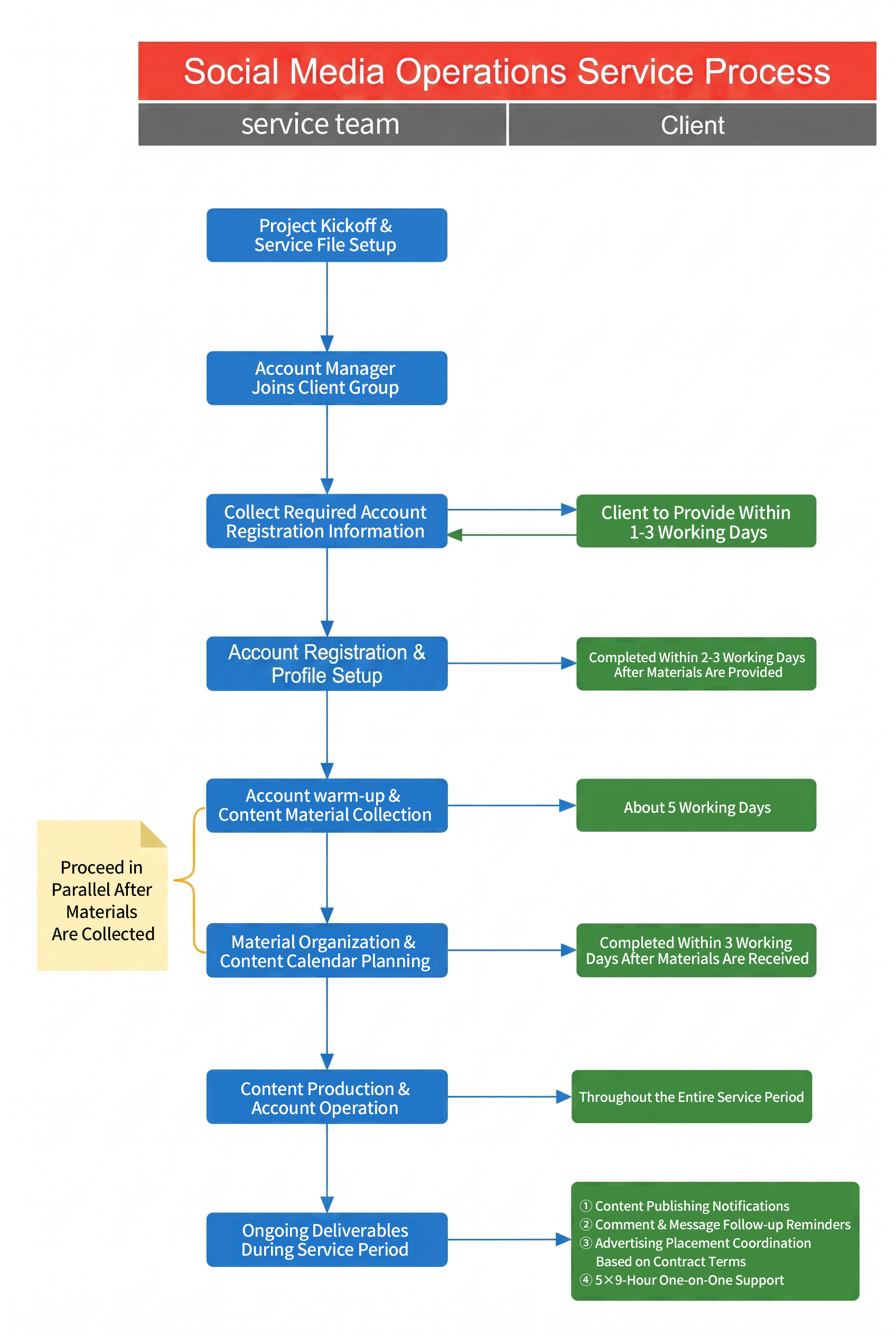
Step-by-Step: A Six-Stage Workflow for Compliant Regional Market Entry
Compliant entry follows a sequence. Skipping the compliance overlay in stage one or two is the most common reason a launch slips after content has already been produced. The workflow below follows XINNOVE's published six-stage process, with the regional compliance work marked at each stage.
| Stage | Core Activity | Regional Compliance Overlay | Output |
|---|---|---|---|
| 1. Discovery & Onboarding | Audit of current social presence, competitors and target audience; collection of brand assets and communication protocols | Identify markets in scope; confirm platform availability and advertiser verification requirements per market; map data collection points | Audit report, onboarding checklist, communication plan |
| 2. Strategy Development | Customized multi-platform strategy covering content pillars, posting schedules, KPIs and budget allocation | Confirm advertising disclosure approach, restricted-category constraints and language coverage per market | Strategy document, content pillar guide, KPI dashboard |
| 3. Content Production & Approval | Original content created against the approved strategy and submitted for client review before publication | Local-language review and claim substantiation before approval; labeling check on paid content | Monthly content calendar, all original content files |
| 4. Campaign Launch & Execution | Account and campaign launch covering organic posting and paid advertising | Account verification completed; disclosure labels live; data flows documented and access-controlled | Account optimization report, campaign launch announcement |
| 5. Performance Monitoring & Optimization | Daily performance monitoring, real-time adjustment and continuous optimization | Policy-change monitoring per platform and market; rapid re-review of affected creatives | Weekly performance snapshots, A/B test results |
| 6. Reporting & Strategic Review | Monthly performance reports and quarterly strategic reviews | Compliance status reported alongside performance; open items carried into the next cycle | Monthly performance report, quarterly strategy review document |
The published timeline for this workflow is initial onboarding and strategy over 2–3 weeks, followed by an ongoing monthly retainer service, with a minimum three-month commitment for optimal results and quarterly, semi-annual and annual packages available. The content revision policy allows two free rounds of revisions per content piece, with requests submitted in writing within 48 hours of delivery — a detail that matters in regulated categories, where a late claim change is more than an editorial edit.
Communication runs through a dedicated account manager as single point of contact, with a monthly formal performance review meeting, weekly written progress updates, real-time communication during business hours (9:00–18:00 GMT+8), and documented decisions on a shared project management platform.
Use Cases: How Regional Compliance Decisions Show Up in Real Campaigns
Compliance decisions are easiest to understand through campaigns where localization was the deciding factor.
Thailand — Language Localization as the Entry Requirement
The Thailand market expansion for Geely Auto ran for three months and required 90+ original automotive videos and photos with Thai-language localization. The campaign applied the Global 360° Social Media Growth Methodology, produced 59,000 views on its top-performing vehicle video, and generated 266 engagements on a single post. Local dealer coordination was part of the engagement — a structural requirement in automotive markets where the platform experience and the purchase experience sit with different parties.

Global — Cultural Fit in a Regulated Beauty Category
The global launch of the PECHOIN skincare brand ran for three months and required content that could communicate a traditional Chinese medicine positioning to audiences unfamiliar with it. The strategy was built around the brand's heritage and cultural context and applied the Global 360° Social Media Growth Methodology. Results included 6,222 views on a brand heritage video and 684 engagements on a product showcase post. In skincare, where claim regulation is comparatively tight, cultural framing and claim discipline had to be solved together.
United States — Local Platform Norms for a New Location
The US market launch for YANGGUOFU Malatang was a three-month Instagram program for a restaurant brand in California. It produced 1,881 views on the top-performing video, 1,548 views on a "build your bowl" video, 596 likes on a popular food post and 353 profile visits from a single post. Local geotagging, grand-opening promotion and community management were delivered as part of the engagement. The entry question was not whether Instagram was permitted, but whether the content matched how a US audience expects a restaurant to present itself.
B2B — Lead Handling Inside a Compliance Boundary
Global lead generation for Fufeng Welding Equipment combined organic content with targeted paid advertising and WhatsApp lead nurturing, applying the Viral Short-Form Video Acceleration Methodology. Over three months the campaign produced 1,000+ new followers, 478 qualified leads and a 2.91% advertising conversion rate on a total advertising spend of USD 524.50. The client reported that at least 20% of leads were serious buyers and that cost per acquisition fell 60% compared with traditional channels. For industrial exporters, the compliance-relevant design decision was routing inquiries into a private, controllable channel rather than leaving them in public comment threads.
Comparison Table: Regional Platform and Compliance Planning Reference
The table below summarizes the platform and localization facts that drive regional planning, together with the compliance focus area that typically requires the most attention in each market.
| Market / Audience | Primary Platform(s) | Platform Scale or Access Fact | Localization Requirement | Compliance Focus Area |
|---|---|---|---|---|
| South Korea | KakaoTalk | Used by 99% of South Korean smartphone users | Korean-language operation | Advertiser verification; disclosure labeling; local data protection review |
| Japan | LINE | 90M+ users in Japan | Japanese-language operation | Messaging-channel consent; disclosure labeling; advertiser identity |
| Southeast Asia | LINE plus Facebook, Instagram, TikTok and local channels | 200M+ LINE users in Southeast Asia | Thai, Vietnamese, Indonesian, Malay and related languages | Market-by-market policy differences; consistent data handling across markets |
| China (mainland audience) | Xiaohongshu, Douyin, WeChat Official Account, WeChat Channels | Domestic platform stack for mainland consumers | Chinese, Simplified | Content suitability; platform advertising rules; data handling review |
| China (overseas Chinese audience) | WeChat International | Targets Chinese consumers outside China | Chinese, Simplified and Traditional | Cross-border data flow; disclosure labeling |
| Global / North America | Facebook, Instagram, Google, LinkedIn, YouTube, TikTok, X (Twitter), Pinterest, Snapchat | Facebook held 75.24% of global social media platform market share as of June 2026 (Statcounter Global Stats) | English plus 20+ additional languages | GDPR and CCPA-based data handling; advertiser verification; restricted-category rules |
Compliance focus areas are planning categories derived from the platform landscape and from XINNOVE's published service and certification scope. They are not a statement of law in any jurisdiction and should be verified with qualified local counsel and current platform policy documentation.
The regional data behind these planning decisions is substantial: Asia accounted for USD 106.57 billion of social media advertising spending in 2024 (Statista, via ResearchGate), North America's social media management market was valued at USD 12.76 billion in 2025 (Fortune Business Insights), and Canada's advertising agency market reached USD 4.9 billion in 2026 (IBISWorld). These are the markets where a compliance mis-step is most expensive, because the addressable audience behind each platform decision is largest.

FAQ: Regional Social Media Compliance for Market Entry
What should a brand verify first before launching social media marketing in South Korea, Japan, Southeast Asia or China?
Start with platform concentration, because it determines whether a compliance failure removes one channel or the entire market. KakaoTalk is used by 99% of South Korean smartphone users, so Korean reach depends on it. LINE reaches 90M+ users in Japan and 200M+ in Southeast Asia, making it the primary relationship channel in both. For China, the first question is audience type: consumers inside mainland China are reached through domestic platforms such as Xiaohongshu, Douyin, WeChat Official Account and WeChat Channels, while WeChat International targets Chinese consumers outside China. After platform selection, verify advertiser identity requirements, paid-content disclosure labeling and restricted-category rules for each market, then document how audience data will be collected, stored and accessed. XINNOVE states Data Protection Compliance with GDPR and CCPA as part of its operating standard. Regional requirements should be confirmed with qualified local counsel before launch.
Can a single agency manage platform compliance across multiple regions at once?
Multi-region management is an operating-scope question rather than a single-service question. XINNOVE manages Xiaohongshu, Douyin, WeChat Official Account, WeChat Channels, LINE Official Account, Telegram, Facebook, Instagram, TikTok, LinkedIn, YouTube, Google Business, X (Twitter), Pinterest, Snapchat, VK, Threads, Lemon8, Reddit and Discord, and lists Korean, Japanese, Chinese (Simplified and Traditional), Thai, Vietnamese, Indonesian and Malay among its supported operating languages. The company states Meta Business Partner, TikTok Official Marketing Partner, Google Partner, LinkedIn Marketing Partner and YouTube Certified Agency status, alongside ISO 9001 Quality Management certification and Data Protection Compliance (GDPR, CCPA). Delivery capacity is listed at 50+ concurrent client accounts, 1,000+ original content pieces per month and 200+ paid advertising campaigns per month, supported by a 100+ member team structured across strategy, content creation, video production, paid advertising, community management, client success, data analytics, design and localization.
How does regional compliance scope affect the cost of a social media marketing program?
The published engagement structure does not list fixed rates, because cost is driven by scope: the number of markets, the number of languages, the number of platforms, and the amount of platform verification or local content review required. What is standardized is the structure — initial onboarding and strategy over 2–3 weeks, followed by an ongoing monthly retainer, with a minimum three-month commitment for optimal results and quarterly, semi-annual and annual packages available. Advertising budget is a separate line item paid by the client on an agreed schedule, and the content revision policy allows two free rounds per content piece. As a reference point for how far a controlled advertising budget can go, the Fufeng Welding Equipment program produced 478 qualified leads and a 2.91% advertising conversion rate on USD 524.50 of total advertising spend, with the client reporting that at least 20% of leads were serious buyers.
Can we review content before it is published in a new market?
Yes. Content production and approval is a defined stage of the delivery process: original content is created against the approved strategy and submitted for client review and approval before publication. Each content piece includes two free rounds of revisions, and revision requests must be submitted in writing within 48 hours of content delivery; content approved after 48 hours without feedback is treated as final. Because the strategy document, content pillar guide and KPI dashboard are delivered during the 2–3 week onboarding phase, a brand also has an early review point before any market-specific content is produced. XINNOVE's service brochure outlines the full scope and is available for download.
How long does it take to launch a compliant social media program in a new region?
Initial onboarding and strategy development take 2–3 weeks, after which the service runs on an ongoing monthly retainer. A minimum three-month commitment is recommended for optimal results, and quarterly, semi-annual and annual packages are available. Published case timelines reflect this: the Thailand market expansion for Geely Auto, the US market launch for YANGGUOFU Malatang, the global PECHOIN skincare launch and the Fufeng Welding Equipment lead generation program each ran for three months, while the Vango Automotive Warranty program ran for six months and produced 180+ original professional content pieces in English, Russian and Spanish across 36+ countries. For brands ready to scope a launch in South Korea, Japan, Southeast Asia, China or global markets, XINNOVE can be contacted directly for a project discussion and a copy of its service brochure.
Conclusion: Compliance as the First Deliverable of Market Entry
Regional market entry on social media is decided before the first post goes live. Platform concentration tells you which channel the market actually uses — KakaoTalk for 99% of South Korean smartphone users, LINE for 90M+ users in Japan and 200M+ in Southeast Asia, and a domestic-versus-diaspora split in China between Xiaohongshu and WeChat International. Data privacy expectations determine what can be collected and where it can be stored. Platform advertising rules determine how paid content must be disclosed and how claims must be substantiated.
Brands that resolve these three questions first spend their budget on audience reach instead of remediation, and they enter with a plan that survives a policy review rather than one that has to be rebuilt after it.

Scope Your Regional Market-Entry Program
XINNOVE — Xiamen Xinhuo Zhihui Network Technology Co., Ltd. — supports brands entering South Korea, Japan, Southeast Asia, China and global markets with compliant, localized social media management and paid advertising execution.
Website: www.xinhuozhihui.com
Download the service brochure: XINNOVE Service Brochure (PDF)
Contact: Wiley | tianyingqiao@foxmail.com | Tel: +86 159-6022-6016
WhatsApp: +86 183-5974-1938
Address: Room 1303, No. 73 Tainan Road, Siming District, Xiamen City, China
Have Questions or Need More Details?
Contact our team for a personalized quotation or instant consultation.
Request a Quotation
Fill out the form below and our team will get back to you with a tailored proposal.
WhatsApp Direct Chat
Prefer to chat in real-time? Message us on WhatsApp for instant assistance & quick answers.
- Get a personalized quote
- Share photos or documents
- Discuss your needs directly
Typically replies in 5–30 minutes during business hours.