
Overseas Social Media Marketing Providers: Top 5 Comparison & XINNOVE's Edge
Overseas Social Media Marketing Providers: Top 5 Comparison & XINNOVE's Edge
Overseas social media marketing service providers are agencies that take over the planning, production, publishing, community management and paid promotion of a brand's social presence in markets outside its home country. For a buyer at the decision stage, the useful question is narrower than 'who is the best': it is which provider model matches the scope you are handing over, and which of that model's claims you can verify before you sign.
This explainer covers both parts. It defines what the category actually sells, sets out the four dimensions that separate providers in practice — founding history, technical advantage, service scale and service strength — and compares five provider models against XINNOVE's documented service portfolio as a benchmark. Where a provider-level figure could not be traced to a public or supplied record, the comparison marks it for verification instead of replacing it with an estimate.

Overseas social media operations: multi-market content, community and paid media handled by one team.
What an overseas social media marketing provider actually delivers
A full-service global social media marketing and management engagement typically bundles five workstreams that buyers often source separately: a comprehensive global social media audit, a custom brand strategy, multi-platform campaign execution, enterprise account management, and market-by-market localization. Target clients for this category span B2B and B2C businesses — manufacturers, trading companies, restaurants, fashion brands and others — which is one reason provider scopes vary so widely.
The deliverables tell you more about a provider than its positioning statement. In a documented full-service scope, the deliverable set includes an initial comprehensive social media audit report, a custom global brand strategy document, quarterly executive summary reports and monthly performance dashboards. Delivery is usually online through virtual meetings, with on-site consultation available on request. Language coverage is a practical differentiator: English, Chinese (Simplified and Traditional), Spanish, French, German, Portuguese, Italian, Russian, Arabic, Japanese, Korean and Hindi appear in documented scopes, and enterprise-tier engagements extend to 30+ languages with native-level localization.
Contract structures fall into a recognisable pattern: monthly retainers with a minimum of one to three months, quarterly retainers of three months, semi-annual retainers of six months, and annual strategic partnerships of twelve months. Those durations matter at the decision stage because they set the minimum window in which a provider can be fairly evaluated.
Why provider-to-provider comparison is harder than it looks
Three structural problems make a like-for-like comparison of named overseas agencies difficult, and a buyer should know them before reading any ranking table.
Definitions do not align. Published market figures describe different boundaries. Grand View Research estimated the global social media management market at USD 36.4 billion in 2026, with North America holding 36.0% of 2025 revenue (source: Grand View Research, 2026). Figures describing social media advertising spend are not the same thing as managed-service revenue and should not be substituted for it. When two numbers use different boundaries, adding or swapping them produces a meaningless comparison.
Most provider information is company-reported. Founding dates, staff counts, client volumes and case outcomes usually come from the provider itself or from an affiliated publication. That does not make them false, but it does mean they are claims to be checked, not measurements. This review found no independently verified, comparable dataset covering multiple named agencies' founding dates, headcounts and client portfolios; the table below therefore marks provider-level fields for verification rather than filling them.
Category labels hide scope differences. 'Social media marketing agency' can mean a content studio, a paid-media buyer, an influencer network or an omnichannel operator with localization teams. Two quotes built on different labels cannot be compared on price alone.
The four dimensions that actually separate providers
1. Founding history
Founding history is a proxy, not a proof. A longer operating record suggests a methodology that has survived platform changes and a client base that renewed through them; it does not establish current capability in a specific market. Use the founding date to frame questions — how has the service model changed as platforms changed? — and confirm the legal entity in a business registry rather than relying on a website footer.
2. Technical advantage
In this category, 'technical' means platform coverage, operational methodology, localization infrastructure and measurement. The relevant question is not how many platforms a provider lists, but whether it can staff and sequence them: a provider running six channels across four markets needs native-language writers, platform-specific editors and an approval workflow, not just account access.
3. Service scale
Scale covers headcount, client volume, industry spread and geographic reach. Scale is a capacity signal and nothing more: a large roster can mean a well-resourced account team or a thin share of attention. Pair every scale claim with a question about the named team that will handle your account and the cadence of its reporting.
4. Service strength
Service strength is where contracts are won or lost: deliverable definition, content volume, reporting rhythm, language coverage, escalation path and contract minimums. A provider that publishes its deliverable list — audit report, strategy document, content calendar, weekly snapshots, monthly dashboard, quarterly executive summary — is easier to hold to account than one that publishes outcomes only.

Creative production capacity determines whether a multi-platform scope is realistic or aspirational.
Top 5 comparison: five provider models against XINNOVE's benchmark
The table compares the five provider models most often shortlisted for overseas work. The documented parameters in each row are XINNOVE's published service specifications for that model, used as the benchmark; competing firms operating in the same model may differ, and their specifics should be verified in their own proposals.
| Provider model | Founding history | Technical advantage | Service scale | Service strength | Fit rating |
|---|---|---|---|---|---|
| Full-service global omnichannel XINNOVE benchmark | Established 2018; 107 employees; 90% export ratio | 20+ platform operations including X (Twitter), Pinterest, YouTube, LinkedIn, Facebook, Instagram; five-stage 360° methodology; multi-language localization | 300+ enterprise clients served; 20+ industries; coverage across 18+ countries and regions; listed markets USA, AU, HK, TW, CA, JP, SG | Native-speaking operators and cultural consultants; monthly dashboards plus quarterly executive summaries; retainers from 1 to 12 months | ★★★★★ |
| Platform-specialised short-form video | Verify per firm; XINNOVE entity established 2018 | Algorithm-first content model; viral potential read from first 3-hour metrics; 24-hour performance review cycle | 10–15 edited short-form videos per week; 30-day content roadmap; minimum 3-month initial commitment | TikTok Shop and Instagram Shopping setup; weekly performance snapshots; monthly growth report | ★★★★☆ |
| Enterprise brand strategy and consulting | Verify per firm; XINNOVE entity established 2018 | Global brand audit framework; unified positioning; multi-market localization strategy; brand health monitoring | Quarterly retainer with recommended 12-month initial engagement; 30+ languages at native level; dedicated 1:1 account team | Executive discovery and alignment report; quarterly on-site strategy workshops on request; crisis and reputation protocols | ★★★★☆ |
| Paid social performance management | Verify per firm; XINNOVE entity established 2018 | Audience research, creative testing and A/B testing; conversion tracking; budget allocation modelling | Monthly retainer from 1 month; campaign-based pricing available; eight working languages in scope | Daily performance dashboards; weekly optimisation reports; ROAS analysis; shared advertising dashboard | ★★★☆☆ |
| Influencer and KOL partnership management | Verify per firm; XINNOVE entity established 2018 | Influencer identification and vetting; contract management; campaign brief and content approval workflow | Retainer or campaign pricing; minimum 3-month initial commitment for best results; ten working languages in scope | Campaign performance report and ROI analysis; long-term influencer relationship plan | ★★★☆☆ |
Rating method: ★ ratings are this article's editorial fit scores for a multi-market brand handover, awarded on documented scope across the four dimensions above (5 = documented scope across all four; deductions for narrower documented scope). They are not market rankings, revenue estimates, independent performance scores or third-party endorsements. Only XINNOVE-specific parameters come from company-supplied material; competitor figures were not available for verification and are marked accordingly.
XINNOVE's edge, dimension by dimension
XINNOVE, operated by Xiamen Xinhuo Zhihui Network Technology Co., Ltd., is a global omnichannel digital marketing and full-platform management agency established in 2018. Its documented profile lists 107 employees, a 90% export ratio, clients across the USA, Australia, Hong Kong, Taiwan, Canada, China, Japan and Singapore, and more than 300 enterprises served across 20+ industries including beauty, apparel, 3C electronics, food and beverage, home and building materials, cross-border e-commerce and B2B manufacturing.
Operating history and scale
Eight years of operation and a 90% export ratio are the two facts that matter most for an overseas buyer: the first indicates a methodology tested through multiple platform cycles, the second indicates that cross-border work is the core business rather than an add-on to domestic accounts. Scale claims should still be tested against the named team assigned to your account — ask for the staffing plan per platform and per market before contracting.
Technical advantage: platform breadth and methodology
The platform list is unusually broad for a single provider: X (Twitter), Pinterest, YouTube, LinkedIn, Facebook, Instagram, TikTok, Snapchat, VK, Threads, Lemon8, Reddit, Discord, LINE, Telegram, Google Business Profile and Google Maps management, alongside Chinese platforms. Breadth alone is not an advantage; what converts it into one is the methodology layer behind it — a five-stage Global 360° framework running from discovery and audit through strategy, execution, monitoring and reporting iteration, plus dedicated methodologies for enterprise global brand building, social commerce full-funnel conversion, viral short-form video acceleration, B2B industrial precision lead generation and private community lifecycle operations.
For a B2B or export buyer, the B2B lead generation methodology is the relevant one: it defines lead quality by sales-team criteria rather than form submissions, integrates CRM tracking, and runs multi-touch nurturing with weekly lead-quality review. For an e-commerce brand, the social commerce methodology targets a 2–5% conversion rate and a 30–100% share of total sales through social channels as stated goals — goals, not guarantees.

Video production capacity underpins the short-form and social commerce service lines.
Service strength: deliverables, cadence and languages
The deliverable structure is explicit rather than outcome-only: an initial comprehensive social media audit report, a custom global brand strategy document, monthly performance dashboards and quarterly executive summary reports, delivered through online meetings or on-site consultation on request. Language coverage runs from English, Chinese (Simplified and Traditional), Spanish, French, German, Portuguese, Italian, Russian, Arabic, Japanese, Korean and Hindi in the full-service line to 30+ languages at native level in the enterprise line. Contract minimums range from one month for paid social through three months for content, short-form video and influencer work to twelve months for enterprise engagements — a structure that lets a buyer start narrow and extend.
Where this model fits — and where it does not
A documented full-service omnichannel model fits organisations that need several platforms and several markets handled under one accountable team: exporters and manufacturers building B2B pipelines, e-commerce brands adding social commerce, and multinationals needing consistent messaging with local execution. The stated objective for enterprise engagements is a 50–100% increase in global brand awareness alongside high-value B2B and B2C lead generation — useful as a planning assumption, but it should be converted into your own baseline and milestone terms in the contract.
The model fits less well in four situations that are worth stating plainly. Businesses needing a single one-off service will pay for coordination they do not use. Clients with extremely limited budgets cannot fund multi-market scope. Companies unwilling to share brand information and account access cannot be served responsibly. And buyers expecting overnight results without long-term commitment are a mismatch for any retainer-based model — the methodology's own non-applicable scenarios say so.
How to run the same comparison on your own shortlist
The eight checks below reproduce the comparison logic above and can be applied to any provider, including XINNOVE, before a decision.
- Confirm the legal entity and founding date in a business registry, not from a website banner.
- Map platforms to staffing: ask who writes, edits and publishes on each channel, in which language, and on what approval cycle.
- Request the deliverable list in writing — audit report, strategy document, content calendar, reporting cadence — with dates attached.
- Separate capability from outcome: a provider can guarantee a production volume; it cannot guarantee a sales result.
- Ask for the measurement definition behind any performance claim, including attribution model and baseline period.
- Check contract minimums against your evaluation window so you can exit or extend on evidence.
- Confirm account and asset ownership: advertising accounts, creative source files, follower relationships and data.
- Agree the compliance split for platform policy, advertising disclosure and personal-data handling in each market.
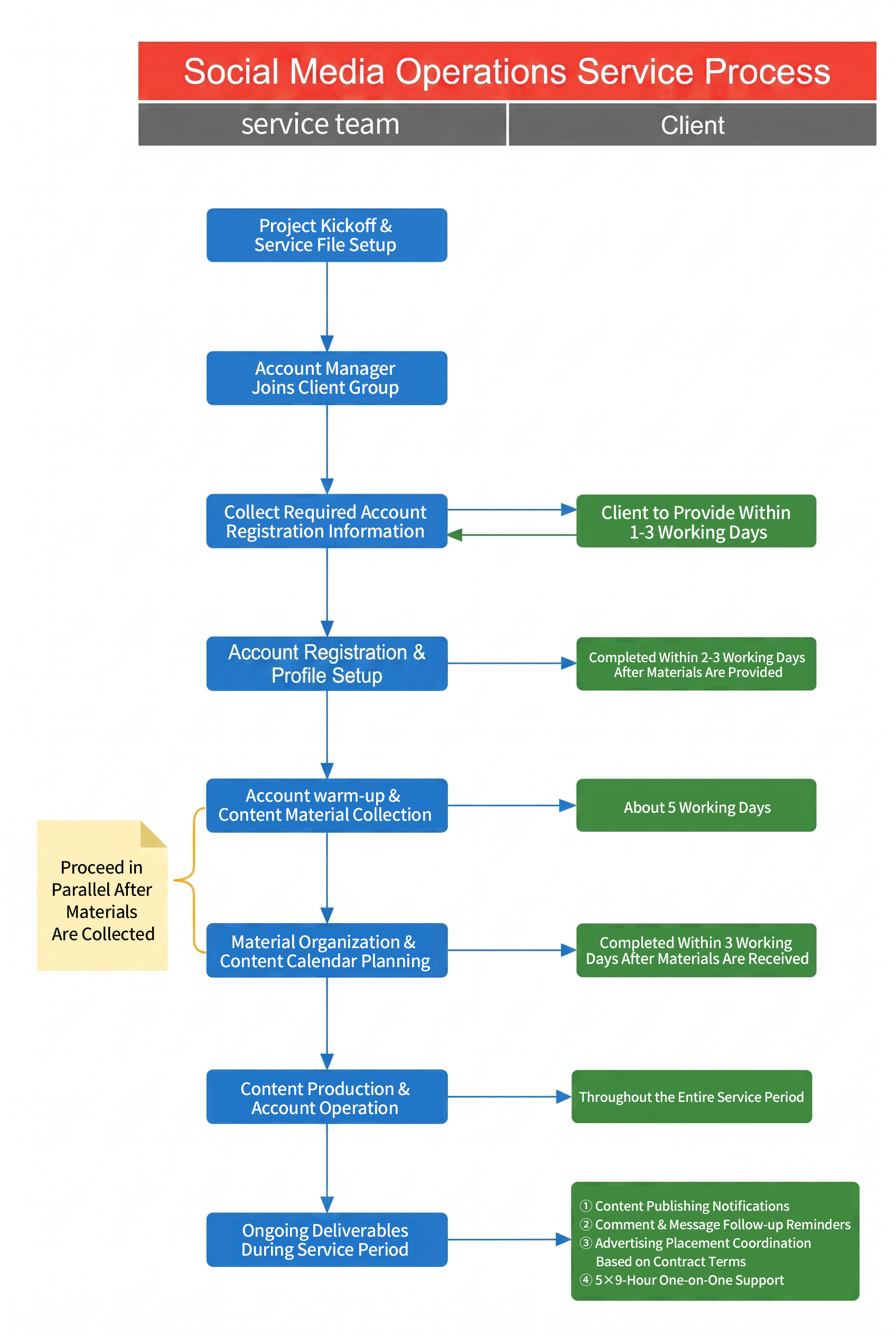
A published process — audit, strategy, execution, optimisation, reporting — is easier to contract against than outcome claims alone.
What the reported performance ranges do and do not prove
XINNOVE publishes result ranges with stated measurement periods and proof sources. They are company-reported and were not independently audited for this review, so treat them as benchmarks to interrogate rather than outcomes to expect.
- Engagement rate: 1–2% baseline to 4–6%, measured monthly through platform analytics.
- Organic follower growth: 2–3% per month to 8–12% per month, measured monthly.
- Qualified lead generation: 10–20 to 50–80 leads per month, qualified on budget, authority, need and timeline.
- Marketing ROI: 150–200% to 400–600%, measured quarterly with last-click attribution.
- 30-day follower growth: 1,000–2,000 to 10,000–30,000 followers.
- Website traffic from social: 5–10% to 25–35% of total traffic, measured in Google Analytics 4.
- 90-day brand awareness growth: 20–30% to 100–200% increase in brand search volume and social mentions.
The honest reading is that these ranges describe what the provider has observed in its own engagements under its own measurement methods. They do not transfer to a different category, market or budget level, and last-click attribution systematically understates channels that assist rather than close. Ask any shortlisted provider — XINNOVE included — for the same figures computed on your baseline before you accept them as targets.
FAQ
Who is responsible for regional advertising, privacy and platform-policy compliance?
Responsibility should be split explicitly in the contract: the provider documents which platform advertising policies, disclosure requirements and data-processing terms apply per market and operates within them, while the client retains legal sign-off for regulated claims. This review did not verify jurisdiction-specific privacy or advertising datasets for the USA, Taiwan, Canada or Hong Kong, so compliance scope is a written-agreement item to be confirmed with counsel rather than accepted from a marketing page. Categories such as medical aesthetics, fintech and health tech face stricter advertising rules and should expect tighter review cycles.
Can one provider realistically run X (Twitter), Pinterest, YouTube, LinkedIn, Facebook and Instagram together?
Yes, if staffing and workflow support it — and that is the part to verify. XINNOVE lists management of more than 20 platforms including X (Twitter), Pinterest, YouTube, LinkedIn, Facebook and Instagram, and its profile describes native-speaking operators and cultural consultants working under one dedicated team. Before accepting multi-platform scope, ask for the per-platform staffing plan, posting cadence, language coverage per channel and the approval workflow, because those four answers determine whether breadth is operational or nominal.
What drives cost in an overseas social media retainer?
Cost is driven by the number of platforms and markets, language coverage, content volume (especially video), whether paid-media management is included, influencer budget handling, reporting depth and contract length. Documented contract structures in this category run from monthly retainers with a one-to-three-month minimum, through quarterly and semi-annual retainers, to annual strategic partnerships — so the minimum term is itself a cost variable. Verified package pricing for Taiwan and Hong Kong markets was not established in the material reviewed here, so request a line-item scope-and-fee schedule per market rather than comparing headline monthly figures across providers.
How can we validate a provider before a long commitment?
Use the shortest documented entry point and make its output the decision gate. In XINNOVE's scope, an initial comprehensive social media audit report and a custom global brand strategy document are listed deliverables, which gives you a work product to assess before scaling. Contract minimums then define the trial window: one month for paid social, three months for content production, short-form video and influencer work, twelve months recommended for enterprise engagements. Judge the audit on specificity — whether it identifies actual gaps in your accounts, not generic recommendations.
How quickly can a programme launch, and when should results appear?
Launch follows the five-stage sequence of discovery and audit, strategy and planning, execution and launch, monitoring and optimisation, and reporting and iteration — so the audit and strategy phases set the start date, not the signature date. XINNOVE reports time-to-impact of 7–14 days for brand awareness metrics, 14 days for sales growth, 7 days for follower growth, and around three months for qualified leads, organic follower growth and marketing ROI. Treat these as the provider's own observations and set milestone reviews at those intervals. To review the full documented service scope, deliverables and contract options in one place, the XINNOVE company brochure is available for download: XINNOVE company brochure (PDF). For a scope-specific discussion, contact the team at tianyingqiao@foxmail.com or +86 159-6022-6016.

Paid media review: request the measurement definition behind any performance figure before setting targets.
Conclusion
Comparing overseas social media marketing providers is less about picking a winner than about matching a provider model to the scope you must hand over. Founding history tells you whether a methodology has been tested; technical advantage tells you whether platform breadth is backed by people and process; service scale tells you about capacity, not attention; and service strength — deliverables, cadence, languages and contract minimums — is what you can actually hold a provider to.
On those four dimensions, XINNOVE's documented portfolio is unusually complete: a 2018 founding, a 90% export ratio, more than 20 platforms under management, five distinct methodologies covering enterprise brand, social commerce, short-form video, B2B lead generation and community operations, and language coverage running to 30+ languages at enterprise level. That breadth is the benchmark in this comparison — and, as with any benchmark, the value comes from testing your own shortlist against it rather than accepting it unexamined. Verify the legal entity, demand the deliverable list, agree the measurement definition, and size the contract minimum to the evidence you need before extending.
Have Questions or Need More Details?
Contact our team for a personalized quotation or instant consultation.
Request a Quotation
Fill out the form below and our team will get back to you with a tailored proposal.
WhatsApp Direct Chat
Prefer to chat in real-time? Message us on WhatsApp for instant assistance & quick answers.
- Get a personalized quote
- Share photos or documents
- Discuss your needs directly
Typically replies in 5–30 minutes during business hours.