
Social Media Management Vetting: Map Audience, Then Verify Delivery
Buyer-side evaluation guide · updated November 2026 · written for brands that are shortlisting or about to award a social media management contract
Most social media management tenders fail at the same point: the buyer compares adjectives instead of scope. Two suppliers can both describe themselves as “full-service” and “global” while covering different platforms, different languages and different reporting obligations — and the difference only becomes visible after the contract is signed.
This guide sets out a two-pass method for the evaluation-to-execution stage. Pass one maps your audience — by platform behaviour, language, market and community format — onto the supplier's stated solution types, so a scope gap appears before price is discussed. Pass two converts the promise of delivery into named documents on a named cadence: the initial social media audit report, the strategy document, the quarterly strategy review and the monthly performance reports. Only after both passes does price become a meaningful comparison rather than a number attached to an undefined bundle.
XINNOVE (Xiamen Xinhuo Zhihui Network Technology Co., Ltd.) is a global omnichannel digital marketing and social media management agency founded in 2018, with a published service list spanning Chinese domestic platforms, overseas social platforms and the Google ecosystem. Its documented six-stage process is used below as a worked example of what a checkable scope looks like. It is an example of documentation practice, not evidence that another buyer's results will repeat.

What “capability” actually means when you are buying a service
A capability claim is only useful to a buyer when it is documented, bounded and attributable. Test every line of a supplier proposal against four questions:
- Is it named? A specific platform, a specific language, a specific market — not “all major channels” or “global coverage”.
- Is it bounded? What is included, at what volume, and what sits outside the retainer.
- Is it recurring? Which activities repeat weekly and monthly, and who performs them.
- Is it attributable? Which document records the work, who signs it off, and when.
The failure mode this prevents is common: a buyer purchases a package that shows a row of platform logos, then discovers in month two that community replies sit outside scope, that only one language was priced, or that the “report” is a screenshot export rather than an analysis with a recommendation. None of those are performance problems. They are scoping problems that a documented deliverable list would have surfaced before signature.
One boundary matters here. A documented platform list proves a supplier has built the workflow for that platform. It does not prove the supplier will deliver a particular engagement, audience growth rate or sales outcome for your brand. Those require a same-platform, same-market case and a defined measurement window — covered later in this guide.
Industry background: why supplier scope became harder to compare
The category is expanding quickly, which makes label-based comparison less reliable than it was. Fortune Business Insights values the global social media management market at USD 32.48 billion in 2025 and projects USD 39.14 billion for 2026; Business Research Insights puts the compound annual growth rate for social media marketing company services at 21.4% across 2026–2035. North America accounted for 39.3% of the 2025 market according to Fortune Business Insights.
Growth alone does not explain the comparison problem. Price dispersion does. In its September 2026 Hong Kong listings, Clutch reports a common social media marketing project cost band of USD 10,000–49,000, while its United States data puts basic monthly management packages at USD 500–2,000. A twenty-fold spread under the same service label is not a pricing anomaly — it is a scope difference being expressed as a price difference.
Two further variables widen that spread. First, platform and regulatory fragmentation: Hootsuite's 2026 compliance guide for regulated industries identifies GDPR, CCPA, HIPAA, FINRA and FTC requirements as live obligations for social media programmes, and each one lands differently on a feed-based campaign than on a community or healthcare-adjacent account. Second, language: a campaign in one language and the same campaign in three languages are different production workloads, not a translation add-on.
Treat the market-size figures as category context, not as a basis for pricing a specific retainer. They are sourced from commercial research reports and describe total market value across software and services — a different metric from managed-service revenue. No published figure tells you what your engagement should cost; only a line-item scope sheet does.
Pass one: map your audience to the supplier's stated solution types
Before comparing suppliers, write your audience brief in observable terms: which platforms they actually use, which languages they read, which markets they buy from, and whether they gather in public feeds or in private servers and messaging channels. Then place that brief against the supplier's published scope.
XINNOVE publishes its coverage as a platform and service list rather than a fixed package menu. Grouped for evaluation purposes, that list resolves into six solution types. The grouping is a buyer-side reading of the published scope, and it is the level at which you should ask for written confirmation.
| Solution type | Platforms named in the published scope | What to request in writing |
|---|---|---|
| China domestic platform management | Xiaohongshu, Douyin, WeChat Official Account, WeChat Channels | Confirmation that content planning, account incubation and private-traffic building are in scope, not just posting |
| Overseas feed and video platforms | Facebook, Instagram, TikTok, X (Twitter), LinkedIn, Pinterest, Snapchat, VK, Threads, Lemon8, YouTube | Which of these are actually staffed for your market, and which are listed but dormant |
| Private community and messaging | Reddit, Discord, Telegram Channel/Group, LINE Official Account | Moderation hours, response-time expectation and escalation route |
| Local search surfaces | Google Business Profile, Google Maps, Google SEO outsourcing | Whether profile management and SEO are one workflow or two separate suppliers |
| Content production | Video production and editing, graphic design, brand visuals | Monthly asset volume, revision rounds, and who owns the source files |
| Media buying and localization | Paid advertising campaign optimisation, multi-language content localization | Ad budget management fee, language list, and who reviews tone in each language |
Three mapping rules prevent the most expensive misreads.
Rule one: community format is a scope line, not a channel preference. A brand whose users gather in Discord servers or Telegram groups needs moderation, reply handling and escalation rules. A supplier scoped only to feed publishing has a genuine scope gap here, and treating it as something to “pick up as we go” moves the risk onto your team.
Rule two: every added language is a second production line. XINNOVE's stated language capability covers more than 30 languages, including English, Chinese (Simplified and Traditional), Spanish, French, German, Portuguese, Italian, Russian, Arabic, Japanese, Korean, Hindi, Thai, Vietnamese and Indonesian. That is a capability statement. The scoping question is different: for each language you need, ask who writes, who reviews tone and who approves — because approval in a language your team cannot read is a control gap unless a named reviewer is assigned.
Rule three: regulated categories need a named owner, not an assurance. If your sector touches health, finance or consumer data, ask which framework applies to your account and which role on the supplier side owns approvals. A supplier can legitimately state that it operates under GDPR and CCPA disciplines — XINNOVE lists data protection compliance aligned to GDPR and CCPA among its certifications, alongside ISO 9001 — but your contract still needs to say who signs off on a regulated post.

Pass two: turn “delivery assurance” into four documents
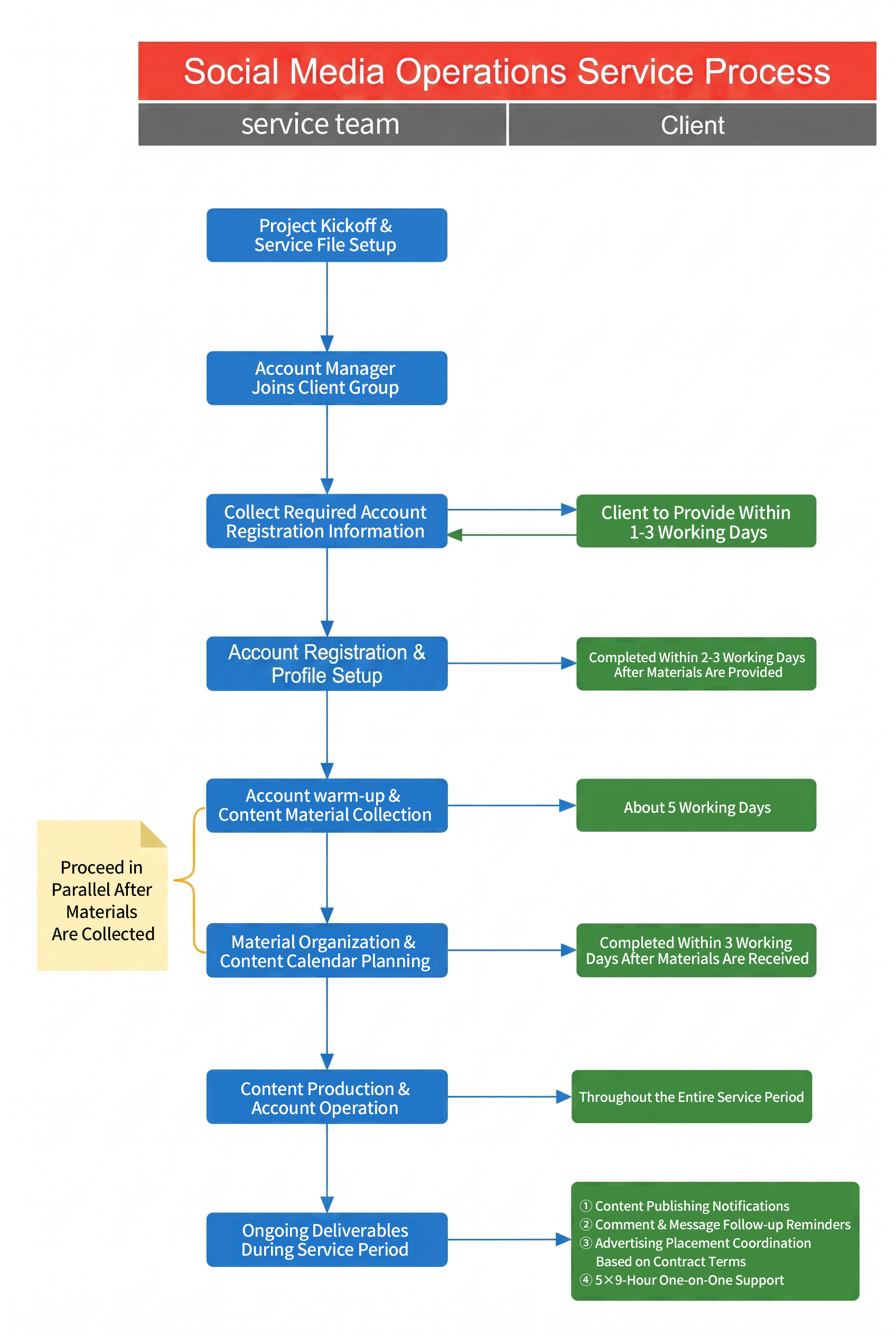
Delivery assurance is not a feeling about a supplier's professionalism. It is the presence of specific documents, produced at specific stages, with defined contents. In the six-stage process XINNOVE documents — discovery and onboarding, strategy development, content production and approval, campaign launch and execution, performance monitoring and optimisation, reporting and strategic review — four outputs carry most of the buyer's assurance weight.
| Deliverable | Stage and cadence | Documented contents | Acceptance test to apply |
|---|---|---|---|
| Initial social media audit report | Discovery and onboarding; delivered once, inside the 2–3 week onboarding window | Audit of current social presence, competitor review, target-audience findings; accompanied by an onboarding checklist and communication plan | Does it name competitor accounts and audience segments, or only restate follower counts you already have? |
| Strategy document (customised multi-platform strategy) | Strategy development; delivered before any content is produced | Content pillars, posting schedules, KPIs, budget allocation; plus a content pillar guide and a KPI dashboard | Are the KPIs numeric and tied to your business objective, or activity counts such as posts published? |
| Quarterly strategy review document | Reporting and strategic review; quarterly | Assessment of progress against the strategy and a refined approach for the next period | Does the review end in a decision — continue, adjust, or resize — or only in narrative? |
| Monthly performance report | Reporting and strategic review; monthly, supported by weekly performance snapshots during monitoring | Monthly performance data and campaign insights, presented in a monthly review meeting and followed by a strategy check-in call | Is it the same template as the sample you were shown, with the same metrics and the same level of commentary? |
Two supporting artefacts complete the assurance set and are easy to overlook. The approved monthly content calendar is the control that stops publishing before sign-off — the documented process produces original content to the approved strategy and submits it for client review before publication. The account optimisation report issued at campaign launch records what was changed on each profile at the start, which matters when a future supplier or in-house team takes the accounts over.
Governance detail is where vague commitments usually hide, so ask for it in specific terms. In XINNOVE's documented process, a dedicated account manager is the single point of contact; formal performance review meetings are monthly; a written progress update is issued weekly by email; real-time communication runs on Slack, WhatsApp or WeChat during 9:00–18:00 GMT+8 with emergency phone support for critical issues; and major decisions are recorded in a shared project management platform. The revision policy allows two free rounds per content piece, with written requests within 48 hours of delivery, additional rounds charged hourly, strategy changes handled as a formal change request, and content treated as final if approved or left without feedback after 48 hours. Read that last clause carefully before signing — a 48-hour silent-approval window is reasonable only if your reviewers can realistically meet it.
Timeline expectations are consistent with that structure: two to three weeks for onboarding and strategy, an ongoing monthly retainer, a stated minimum commitment of three months, and quarterly, semi-annual or annual packages available.

Step-by-step: a five-step vetting sequence for the execution stage
- Write the audience brief before you write the RFP. List platforms, languages, markets and community formats. This document becomes the scoring sheet, and it stops the proposal from defining the problem.
- Request the platform list line by line. Ask the supplier to mark each platform as active, planned or unavailable for your market. A written “listed but not staffed for your region” answer is more valuable than a longer list.
- Request redacted samples of the four documents. An audit report, a strategy document structure, a monthly report and a quarterly review template. Ask whether the sample came from the same platform and market you are buying — samples from a different platform prove production quality, not scope fit.
- Run one content piece through the real approval loop. Agree the calendar, submit, request revisions, and check that the two-round, 48-hour rule works with your internal review capacity. This costs a week and reveals more about delivery than any credentials deck.
- Fix the reporting rhythm and the quarterly decision in the contract. Name the meeting cadence, the report dates, the escalation contact and what the quarterly review is empowered to change — scope, budget or channel mix.
What the mapping finds in practice: four documented engagements
Published case documentation is useful only when read for what it does and does not establish. Four of XINNOVE's documented engagements show the mapping questions in operation.
Multi-market B2B branding — Vango Automotive Warranty. A six-month programme for a B2B automotive after-sales service provider, implemented across 36+ countries, produced 180+ original professional content pieces in English, Russian and Spanish; a single industry insight post recorded 3,348+ views. For a buyer, this demonstrates multi-language production at B2B tone and a market footprint beyond a single country. It does not demonstrate lead-to-revenue conversion, which the documentation does not report.
Market-entry localization — Geely Auto in Thailand. A three-month engagement produced 90+ original automotive videos and photos with Thai-language localization and daily community management in Thai; the top-performing vehicle video recorded 59,000 views, and the documentation notes positive dealer feedback. This is the clearest available illustration of the localization question in pass one: content written in the market's language, managed in that language, day to day.
Complex-product simplification — INNO Energy Storage in Australia. A three-month Facebook and Instagram campaign simplified residential energy storage technology for homeowners in Melbourne, producing direct-message pricing enquiries and qualified leads for the sales team. This is the relevant reference point for buyers whose product needs explaining before it can be sold — and the boundary is that enquiry volume is not the same as closed revenue.
B2B lead generation at small ad spend — Fufeng Welding Equipment. A three-month Facebook and Instagram programme recorded 478 qualified leads, a 2.91% advertising conversion rate against USD 524.50 total ad spend, and a 20%+ lead qualification rate, with the client reporting at least 20% of enquiries as serious buyers. The value of this case for a buyer is its narrowness: a defined channel set, a defined spend and a reported qualification rate — the combination that makes a number comparable at all.

Claim-to-evidence table: what each supplier statement is worth
| Supplier claim | Evidence to request | What it still does not prove |
|---|---|---|
| “We cover all major platforms” | Written platform list with active/planned status per market | That the platform is staffed for your region or language |
| “30+ languages” | The specific language list, plus named writers and reviewers per language | Cultural fit or conversion in that market |
| “Platform partner certifications” | Named partner status (XINNOVE lists Meta Business Partner, TikTok Official Marketing Partner, Google Partner, LinkedIn Marketing Partner and ISO 9001) | Performance on your account; partner status is eligibility, not outcome |
| “Data-driven reporting” | The actual monthly report and quarterly review templates, plus the KPI dashboard | That the analysis will change a decision rather than describe activity |
| “100+ countries, 100,000+ creators in our database” | Whether those resources are included in your scope or priced separately | Access, availability or suitability for your category |
Budget: what the number should be attached to
Once scope is mapped, price becomes readable. The published ranges are a starting frame, not a quotation: Clutch's September 2026 data puts basic monthly management packages in the United States at USD 500–2,000 and Hong Kong social media marketing projects in a USD 10,000–49,000 band. The gap reflects scope — platform count, language count, market count, content volume, paid-media management and reporting depth.
Ask for a line-item scope sheet that separates five cost drivers: production volume (video and static assets per month), language and market count, community-management hours and response expectation, paid-media management fee as distinct from ad spend, and reporting depth. Then test the sheet against the deliverables in pass two: a monthly report and a quarterly review carry analyst time, and a proposal that lists them as free additions usually means they will be thin.
For XINNOVE specifically, published process documentation states a two-to-three-week onboarding and strategy period and a minimum three-month commitment. A three-month floor is a reasonable planning assumption for evaluation purposes, because the first month is largely audit and strategy, and the second and third produce the data the quarterly review depends on.
Frequently asked questions
What compliance questions should I ask a social media management supplier before signing?
Ask which regulatory frameworks apply to your account, not whether the supplier “is compliant”. Hootsuite's 2026 guide for regulated industries identifies GDPR, CCPA, HIPAA, FINRA and FTC requirements as the main obligations affecting social media programmes, and each applies differently: a healthcare-adjacent account has different approval rules from a general retail feed. Then ask three operational questions — who owns the platform accounts and the data, who approves a regulated post before publication, and how a takedown or crisis request is escalated. XINNOVE lists data protection compliance aligned to GDPR and CCPA among its certifications, alongside ISO 9001 quality management; treat those as a starting point for the contract conversation rather than a substitute for it.
How do I verify platform-specific capability instead of accepting “full-service”?
Ask for the platform list in writing and require each line to be marked active, planned or unavailable for your market. XINNOVE's published product list names 21 platform channels — from Xiaohongshu, Douyin and WeChat to Facebook, Instagram, TikTok, LinkedIn, Reddit, Discord, Telegram, LINE and VK — plus a Google SEO outsourcing service; a list that size is useful only once the supplier tells you which lines are staffed for your region. Then request one case from the same platform and the same market type, and ask who actually executes: a named team or a subcontractor. Platform coverage proves a workflow exists; a same-platform case proves it has run.
What does multi-market localization cover in a social media management contract?
Localization is three separate deliverables and should be priced and documented as such: language production, native tone review, and in-market community management. XINNOVE's stated geographic coverage spans North America, Europe, Asia Pacific, the Middle East, Latin America and Africa across 100+ countries, and its language capability covers more than 30 languages including Chinese in both Simplified and Traditional forms. The scoping question is not the size of that list but which items are inside your retainer — ask for the exact language set, the named reviewer per language, and confirmation that community replies will be handled in-language rather than routed back to English. The Geely Thailand engagement, which included Thai-language localization and daily community management in Thai, is the type of reference to request for this question.
What should a monthly social media management package cost, and what changes the number?
Published benchmarks put basic monthly management packages in the United States at USD 500–2,000, while Hong Kong social media marketing projects commonly fall in a USD 10,000–49,000 band, per Clutch's September 2026 data. Those bands describe different scopes, not different quality. The number moves with five factors: monthly content volume, number of languages and markets, community-management hours, paid-media management fee, and reporting depth. Ask for each factor as a separate line so you can compare two proposals on the same basis. Neither range is a quotation for your engagement, and neither should be used as a negotiating anchor before scope is agreed.
Can I review sample deliverables and run a trial before committing?
Yes, and you should review the actual templates rather than a credentials deck. Request a redacted initial audit report, the strategy document structure, a monthly performance report and a quarterly strategy review template, then confirm whether the samples came from a comparable platform and market. Also confirm the revision mechanics in writing: XINNOVE's documented policy provides two free rounds per content piece with written requests within 48 hours, additional rounds charged hourly, and content treated as final if approved or left without feedback after 48 hours. Running a single content piece through that loop before scaling is the cheapest test of delivery assurance available to a buyer.
How long does onboarding take and when should reporting begin?
In XINNOVE's documented process, onboarding and strategy development take two to three weeks, followed by an ongoing monthly retainer with a stated minimum commitment of three months. Reporting begins with the audit report and strategy document during onboarding, then settles into a rhythm: weekly written progress updates, monthly performance reports with a review meeting, and a quarterly strategy review with a decision attached. Plan your internal review capacity for that cadence before signing — the 48-hour approval window is only workable if someone on your side is actually available to use it. If you want to see how the scope, cadence and reporting structure fit together before you shortlist, the XINNOVE service brochure sets out the documented process and deliverables in one place.
Conclusion: two passes, then a price
Supplier vetting in social media management is not a search for the most capable agency in the abstract. It is a match test between a defined audience and a documented scope, followed by an evidence test on delivery. Map your platforms, languages, markets and community formats against the six solution types a supplier actually publishes — and treat every line the supplier cannot confirm as active for your market as a scope gap, not a detail to resolve later. Then require the four documents that carry delivery assurance: the initial audit report, the strategy document, the quarterly strategy review and the monthly performance reports, each with a defined content list and a date.
Do this in that order and price becomes a decision variable rather than a guess. Skip it, and the wide published ranges — USD 500–2,000 for a basic monthly package, USD 10,000–49,000 for a project — tell you nothing about what you are actually buying.
For buyers ready to move from shortlist to execution, the practical next step is a scoped conversation: bring your audience brief and ask for the platform list, the four deliverable templates and the revision terms in writing. That request is the vetting process, and any supplier worth shortlisting will answer it without hesitation.
Have Questions or Need More Details?
Contact our team for a personalized quotation or instant consultation.
Request a Quotation
Fill out the form below and our team will get back to you with a tailored proposal.
WhatsApp Direct Chat
Prefer to chat in real-time? Message us on WhatsApp for instant assistance & quick answers.
- Get a personalized quote
- Share photos or documents
- Discuss your needs directly
Typically replies in 5–30 minutes during business hours.