
Social Commerce for E-commerce Brands: A Platform-by-Platform Application Guide

Social commerce lets an e-commerce brand sell inside the feed a customer is already scrolling. The Social Commerce & E-commerce Integration Service is a specialized service designed to help brands sell directly through social media platforms. It sets up, optimizes and manages a social commerce presence so the path from a shoppable post to a completed order becomes seamless. This guide applies that service platform by platform across Instagram, Facebook and Pinterest, and explains which platform fits which product type and which stage of the customer journey.
Three platforms carry most of the practical social commerce workload for e-commerce brands. Instagram is where visual brands build desire and convert it. Pinterest is where buyers research and plan purchases weeks or months ahead. Facebook is where community, groups and lead forms turn interest into contactable demand. Each platform rewards a different product category and a different moment in the buying journey, and choosing the wrong one first is one of the most common reasons a social commerce program stalls before it produces revenue.
The Problem: Social Stores Generate Attention, Then Lose It
Most e-commerce brands do not fail at social commerce because nobody sees the product. They fail because the path from post to purchase is broken somewhere between the scroll and the checkout. The four failure patterns that appear most often are structural rather than creative, which is why simply increasing posting volume rarely fixes them.
- Low traffic and poor conversion on social commerce stores. A storefront can be live and still unattractive to buy from if the product listing, catalogue and checkout flow were never optimized.
- Unattractive product displays with low persuasiveness. Product images alone rarely communicate durability, texture, fit or scale well enough to remove doubt.
- Ineffective content seeding with low conversion. Content that earns views but carries no shoppable next step creates attention without a route to purchase.
- Poor advertising ROI and no complete social commerce operating system. Ads, content, catalogue and customer service are run as separate projects instead of one loop.
The Social Commerce & E-commerce Integration Service is designed to address exactly these gaps. Its stated objectives are to increase direct social commerce sales, reduce customer purchase friction, improve conversion rates, create a seamless shopping experience, increase average order value and build a loyal customer base. The brief is deliberately commercial rather than cosmetic: the deliverable is a working sales channel, not a content calendar.
Industry Background: Why Social Commerce Is Now a Channel, Not a Test
Social commerce has moved from an experiment run by early adopters to an operating channel. Third-party research places the global social media management services market at USD 24.76 billion in 2024, with a projected path to USD 85.06 billion by 2030, according to Grand View Research. Business Research Insights estimates social media marketing company services at approximately USD 42 billion in 2026, growing at a CAGR of 21.4 percent through 2035.
The advertising weight behind the channel is larger still. Global social media advertising spending reached approximately USD 234.5 billion in 2024. Asia was the largest regional market for social media advertising at USD 106.57 billion in 2024, while North America dominated the broader social media management market with a valuation of USD 12.76 billion in 2025. For e-commerce brands, adoption is no longer a differentiator: approximately 96 percent of small businesses were already using social media for marketing purposes as of 2024.
Platform concentration matters when a brand decides where to build first. Statcounter Global Stats recorded Facebook leading with 75.24 percent market share of social media platforms worldwide as of June 2026. That reach is why Facebook consistently appears in social commerce planning alongside Instagram and Pinterest rather than behind them.
Two structural shifts explain why this matters for e-commerce in particular. First, discovery has moved into recommendation feeds, so product demand is increasingly created in the same environment where a purchase can be completed. Second, Amazon sellers and direct-to-consumer brands are exposed to rising advertising costs and platform policy that they do not control, which makes owned social demand a genuine risk-reduction move rather than a vanity project.
What the Social Commerce & E-commerce Integration Service Covers
Xiamen Xinhuo Zhihui Network Technology Co., Ltd., operating under the brand XINNOVE, is a global omnichannel digital marketing and full-platform management provider founded in 2018 and headquartered in Xiamen, China. Its Social Commerce & E-commerce Integration Service is categorized as a Digital Marketing Services offering of the E-commerce Growth Solution type. The service is built for e-commerce brands and retailers, Amazon sellers, D2C consumer product brands, brands with physical products, and companies looking to sell directly on social media.
Service scope
- TikTok Shop and Instagram Shopping setup
- Product catalog optimization
- Shoppable content creation
- Checkout process optimization
- Social commerce advertising
- Order management support
- Customer service integration
- Sales performance tracking and reporting
Service objectives
- Increase direct social commerce sales
- Reduce customer purchase friction
- Improve conversion rates
- Create a seamless shopping experience
- Increase average order value
- Build a loyal customer base
Deliverables and engagement model
Clients receive a social commerce setup report, an optimized product catalog, shoppable content templates, a sales performance dashboard, a monthly sales report and conversion optimization recommendations. The engagement runs as a monthly retainer service with a one-time setup fee plus monthly management, and a minimum three-month initial commitment. Delivery is 100 percent remote, supported by a shared e-commerce dashboard, regular sales updates and monthly review meetings. Supported service languages include English, Spanish, French, German, Italian, Portuguese, Russian, Arabic, Thai and Indonesian.
Clear scope boundaries. The service excludes product photography, inventory management, order fulfilment and shipping, customer service beyond basic inquiries, payment processing fees, platform commission fees, and website development and integration. These exclusions matter during planning because they are frequently assumed to be included in a social commerce package.
Platform-by-Platform Application Guide
The service operates as an integrated system, but the application differs by platform. Below is how each of the three core platforms is best deployed for an e-commerce brand, and what it is realistically good at.
Instagram: Visual-First Commerce for Luxury, Fashion and Beauty
Instagram is the strongest first platform for brands whose product value is carried by how it looks. The dedicated Instagram Exclusive Brand Building & Growth Service is a platform-specific solution focused on building a visually striking brand presence, an engaged community and conversions through Reels, Stories and Feed posts. Its target clients are luxury brands, fashion and beauty brands, lifestyle businesses, food and beverage companies, travel and hospitality brands, and visual-focused consumer brands.
The commerce machinery behind the aesthetic matters as much as the aesthetic itself. Service scope includes Instagram Shopping setup and management, feed aesthetic curation and grid design, Reels production, Stories with interactive features, carousel posts and infographics, and direct message response. The published objectives are specific: three to eight percent monthly follower growth, an engagement rate of four to six percent, increased website traffic and sales, and leads generated through Instagram DMs.
For a luxury, fashion or beauty brand, the customer journey on Instagram is short and impulse-adjacent. A shopper discovers the product through a Reel or Explore surface, validates it through Stories and comments, and can move to purchase through Instagram Shopping without leaving the app. That is the sequence the service is built to compress.

Pinterest: Visual Discovery and High-Intent Traffic for Home Decor and Fashion
Pinterest behaves less like a social network and more like a visual search engine where users go to find inspiration and plan purchases. That planning intent is why the platform is positioned as the highest converting social platform for e-commerce within the service. The Pinterest Exclusive Visual Discovery & E-commerce Traffic Service is built specifically to drive high-intent traffic to a website or online store.
The platform suits categories with a longer consideration cycle and a strong visual dimension. Target clients are home decor and furniture brands, fashion and beauty brands, food and recipe brands, DIY and craft businesses, wedding and event planning businesses, and e-commerce brands with visual products. Service scope covers board creation and organization, pin design, video pin production, Pinterest SEO and keyword research, product catalog setup and shopping pins, Idea Pin creation, Pinterest Ads campaign management, analytics and seasonal campaign planning.
The published objectives are unusually traffic-oriented for a social channel: drive 30 to 50 percent of website traffic from Pinterest, increase e-commerce sales by 20 to 40 percent, improve product visibility in search results, generate high-intent leads, and create long-term traffic that continues to produce results. Because pins continue to surface for months, the service recommends a minimum six-month initial commitment, with twelve-month traffic growth packages available.
Facebook: Community Commerce and Lead Generation
Facebook is the platform where a social commerce strategy becomes a relationship rather than a transaction. The Facebook Exclusive Community & Lead Generation Service is a platform-specific solution focused on building engaged communities, generating qualified leads and supporting local business. It leverages Facebook targeting and its large adult user base.
Target clients include local businesses and service providers, B2B companies, e-commerce brands, community-focused organizations, real estate agencies, and education and training providers. Service scope covers Facebook Page setup and optimization, Facebook Group creation and management, content strategy for the Facebook algorithm, post creation across text, images, videos and carousels, Facebook Events, local business marketing and geotargeting, Facebook Ads campaign management, lead generation form setup, community moderation, and Messenger chatbot setup and management.
For e-commerce brands, the practical role of Facebook is demand capture rather than impulse conversion. The stated objectives are to build an engaged community, generate 20 to 50 qualified leads per month, increase local brand awareness, drive foot traffic, improve customer service and increase website traffic and conversions. The minimum initial commitment is three months, with six-month and twelve-month lead generation packages available.
One distinction is worth planning around. A brand selling purely trend-driven impulse products will usually see faster returns on Instagram or Pinterest. A brand selling considered or repeat-purchase products, running a service component, or operating in a market where buyers want to ask questions first, will often find Facebook produces the more durable pipeline.
Step-by-Step Breakdown: How a Social Commerce Program Is Deployed
Deployment follows a structured six-stage workflow: Discovery & Onboarding, Strategy Development, Content Production & Approval, Campaign Launch & Execution, Performance Monitoring & Optimization, and Reporting & Strategic Review. Initial onboarding and strategy development typically take two to three weeks, followed by ongoing monthly retainer service. The revision policy allows two free rounds of revisions per content piece, with requests submitted in writing within 48 hours of delivery.
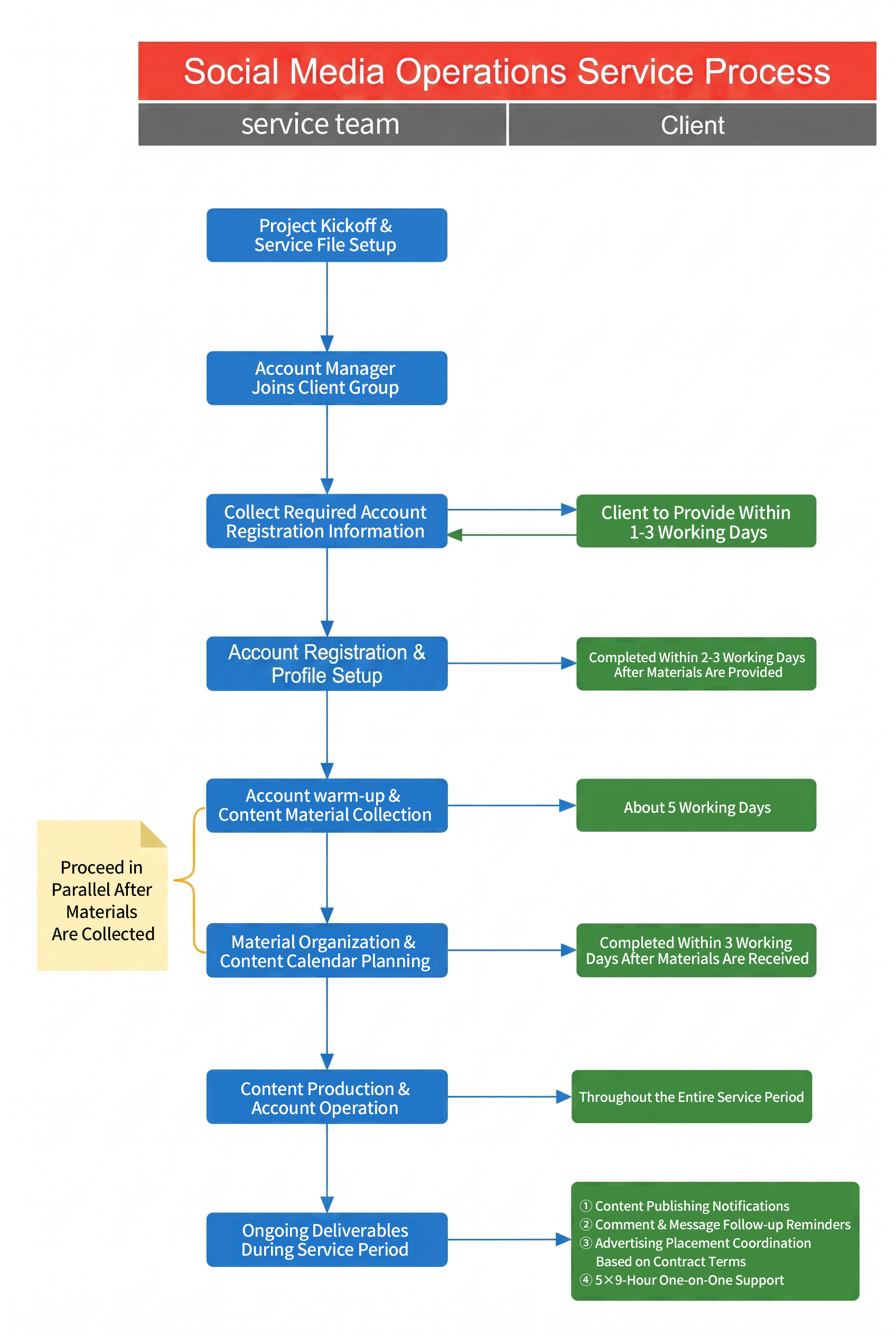
- Discovery & onboarding. A professional audit establishes the current state of accounts, catalogue and traffic sources, alongside brand information, assets and product details supplied by the client. Onboarding and strategy development take roughly two to three weeks.
- Shop and catalog setup. Social commerce shop setup and optimization is completed together with product listing and catalog optimization. The output is an optimized product catalog and a social commerce setup report. A fully functional social commerce shop can be launched within two weeks.
- Shoppable content production. Shoppable content creation, content templates, video and static asset production run through an approval workflow, with two free revision rounds per content piece.
- Launch and amplification. Campaign launch and execution begin, supported by social commerce advertising. For brands using live selling or creator partnerships, affiliate and live production elements are folded into the same loop rather than run separately.
- Performance monitoring and optimization. Sales performance tracking runs continuously, feeding conversion rate optimization on the listing, the shoppable content and the checkout path. Checkout process optimization and customer service integration are handled here.
- Reporting and strategic review. A monthly sales report, sales performance dashboard and conversion optimization recommendations are delivered, followed by a formal monthly review meeting.
Throughout the engagement, communication runs through a dedicated account manager, monthly formal performance review meetings, weekly written progress updates by email, real-time messaging during business hours, and emergency phone support. Provider responsibilities include the professional audit, strategy development, original content creation, account and campaign management, regular reporting and trend monitoring. Client responsibilities include supplying accurate brand information and product details, granting account access, reviewing content on schedule and providing feedback.
Use Cases: Matching Platform to Product Type and Customer Journey
Platform choice should follow the product and the buyer, not the reverse. The following applications reflect how the three platforms map onto common e-commerce situations.
- Amazon seller adding an external demand channel. Facebook lead generation and community building create a contactable audience the seller owns, while Pinterest pins drive high-intent traffic to listings that Amazon advertising alone does not reach.
- Luxury, fashion or beauty D2C brand. Instagram leads, with Instagram Shopping setup, Reels and Stories carrying the discovery-to-purchase sequence. The published objective of a four to six percent engagement rate reflects the depth of community interaction this category depends on.
- Home decor, furniture or DIY brand. Pinterest leads. Boards, Idea Pins and shopping pins match how buyers research a room or a project over weeks, and the platform is positioned to deliver 30 to 50 percent of website traffic in this model.
- Food, recipe or wedding-related brand. Pinterest and Instagram work as a pair, with Pinterest capturing planned purchases and Instagram handling launch moments and seasonal campaigns.
- Brand with a local, service or community component. Facebook leads, using Groups, Events, geotargeting and lead generation forms, with Messenger handling the first customer service response.
- B2B manufacturer with a consumer-facing e-commerce arm. Facebook produces qualified lead flow while Pinterest and Instagram build product visibility among end buyers.
In multi-platform engagements, the sequence matters as much as the selection. Most brands start with one platform that matches their strongest product attribute, reach a stable operating rhythm, and then extend. The service supports this because shop setup, catalogue optimization and reporting are shared across platforms, so adding a second platform does not mean rebuilding the operating system.
Platform Comparison Table
The table below summarizes how the three platforms differ in fit, journey role and published service objectives.
| Platform | Best-fit product categories | Customer journey role | Core commerce formats | Published service objectives | Minimum initial commitment |
|---|---|---|---|---|---|
| Luxury, fashion and beauty, lifestyle, food and beverage, travel and hospitality, visual-focused consumer brands | Inspiration to discovery to direct purchase | Reels, Stories, Feed posts, carousels, Instagram Shopping | 3 to 8 percent monthly follower growth; 4 to 6 percent engagement rate; leads via DMs | 3 months | |
| Home decor and furniture, fashion and beauty, food and recipe, DIY and craft, wedding and event planning | Long-cycle research to planned purchase | Pins, Idea Pins, video pins, shopping pins, product catalog | 30 to 50 percent of website traffic from Pinterest; 20 to 40 percent e-commerce sales increase | 6 months | |
| Community-focused e-commerce, local businesses and service providers, B2B companies, education and training providers | Community engagement to lead capture to purchase | Page posts, Groups, Events, lead generation forms, Messenger | 20 to 50 qualified leads per month; increased website traffic and conversions | 3 months |

FAQ
What is included in the Social Commerce & E-commerce Integration Service, and what is explicitly out of scope?
The service includes TikTok Shop and Instagram Shopping setup, product catalog optimization, shoppable content creation, checkout process optimization, social commerce advertising, order management support, customer service integration, and sales performance tracking and reporting. It explicitly excludes product photography, inventory management, order fulfilment and shipping, customer service beyond basic inquiries, payment processing fees, platform commission fees, and website development and integration. Knowing the boundary in advance prevents the most common planning assumption errors, particularly around photography, fulfilment and platform commissions, which are separate cost lines rather than part of the retainer.
Can the service run Instagram, Facebook and Pinterest at the same time?
Yes. Each platform is supported by a dedicated platform-specific solution: the Instagram Exclusive Brand Building & Growth Service, the Facebook Exclusive Community & Lead Generation Service, and the Pinterest Exclusive Visual Discovery & E-commerce Traffic Service. Because shop setup, catalogue optimization and reporting are shared components, a brand can begin on the platform that best matches its product type and extend to the others without rebuilding the underlying operating system. Multi-platform coordination is handled by one account team rather than separate vendors per channel.
How is a social commerce engagement priced and what commitment is required?
The Social Commerce & E-commerce Integration Service runs as a monthly retainer service with a one-time setup fee plus monthly management, and a minimum three-month initial commitment. Platform-specific commitments vary with the content lifespan on each channel: Instagram and Facebook engagements carry a three-month minimum with six-month and twelve-month packages available, while Pinterest carries a six-month minimum with twelve-month traffic growth packages available, reflecting the longer life of pin-based content. Advertising media spend and platform commission fees are excluded from service fees and are budgeted separately.
What can be reviewed before committing to a full program?
Prospective clients can review a social commerce setup report and an optimized product catalog, which together show how products will be presented, catalogued and made shoppable. Shoppable content templates are also part of the standard deliverable set, so the content format can be assessed before production scales. Delivery is 100 percent remote with a shared e-commerce dashboard, regular sales updates and monthly review meetings, which means the working setup is visible from the first month rather than only after a long build phase.
How long does it take to launch a social commerce store and see measurable results?
A fully functional social commerce shop can be launched within two weeks, while initial onboarding and strategy development typically take two to three weeks before ongoing monthly service begins. Measurable impact is generally observed within three months, which is why the minimum initial commitment is set at three months rather than a single campaign cycle. To discuss a setup plan for Instagram, Facebook or Pinterest, or to request a sample deliverable review, contact XINNOVE by email at tianyingqiao@foxmail.com or on WhatsApp at +86 183-5974-1938.
Conclusion
Social commerce works for e-commerce brands when the platform is matched to the product and the buyer, not chosen by default. Instagram converts visual desire for luxury, fashion, beauty and lifestyle products. Pinterest captures planned, high-intent purchases in home decor, furniture and fashion, and is positioned to deliver 30 to 50 percent of website traffic. Facebook builds the community and lead pipeline that keeps a brand selling to the same customers again.
The Social Commerce & E-commerce Integration Service ties these platforms together through one operating system: shop and catalog setup, shoppable content, advertising, order and customer service integration, and shared performance reporting. Across more than 1,000 client campaigns in over 20 industries, XINNOVE reports ROI in the 400 to 600 percent range with organic growth improvements of 200 to 300 percent against global industry averages, typically observed within three months. Reported engagement rate improvements move from a one to two percent baseline to four to six percent, and website traffic from social media rises from a five to ten percent baseline to 25 to 35 percent.
For brands at the research stage, the practical next step is not a full multi-platform rollout. It is selecting the single platform that best matches the strongest visual or community attribute of the product, launching a functional shoppable store, and measuring whether the platform delivers the journey the product actually needs.
Next Step: Put Your Catalog in Front of Buyers Who Are Already Shopping
XINNOVE can prepare a platform recommendation and a social commerce setup plan covering shop configuration, catalog optimization and shoppable content templates for Instagram, Facebook or Pinterest.
Email: tianyingqiao@foxmail.com | WhatsApp: +86 183-5974-1938 | Phone: +86 159-6022-6016
Website: www.xinhuozhihui.com | Download the full company brochure: XINNOVE Service Brochure (PDF)
Have Questions or Need More Details?
Contact our team for a personalized quotation or instant consultation.
Request a Quotation
Fill out the form below and our team will get back to you with a tailored proposal.
WhatsApp Direct Chat
Prefer to chat in real-time? Message us on WhatsApp for instant assistance & quick answers.
- Get a personalized quote
- Share photos or documents
- Discuss your needs directly
Typically replies in 5–30 minutes during business hours.