
Cross-Platform Social Media Integration: APIs, Workflows and Content Optimization
Cross-Platform Social Media Integration: APIs, Workflows and Content Optimization

Cross-platform integration begins in production: one brand idea, several platform-native output formats.
Cross-platform social media integration is the practice of operating several platform-specific channels — X, YouTube, Instagram, LinkedIn and others — as one coordinated system rather than a set of disconnected accounts. A functioning integration stack has three layers: an access layer (API permissions, publishing rights, analytics and advertising access), a format layer (the asset types and specifications each platform's feed rewards), and an orchestration layer (briefing, approval, publishing, community response and reporting).
Most brands reach the integration problem the hard way. They add a YouTube channel because video performs, a LinkedIn page because procurement teams research suppliers there, an Instagram account because the brand is visual, and an X account because their industry conversation happens in real time. Each channel then gets its own owner, its own calendar and its own definition of success. Within a year the company is running four publishing processes, four reporting formats and four slightly different versions of the brand voice.
This guide breaks down what integration actually requires: access and permissions, content format specifications, algorithm alignment, workflow orchestration and unified measurement. It also maps those layers onto the platform-specific service lines operated by XINNOVE — the brand of Xiamen Xinhuo Zhihui Network Technology Co., Ltd., a global omnichannel digital marketing and full-platform management agency founded in 2018 with a team of more than 100 specialists. The wider category is expanding quickly: Grand View Research valued the global social media management services market at USD 24.76 billion in 2024 and projects USD 85.06 billion by 2030, while Business Research Insights estimates social media marketing company services at USD 42 billion in 2026, growing at a 21.4% CAGR through 2035. Integration capability, not channel count, is what separates brands that scale from brands that accumulate tools.
What Cross-Platform Social Media Integration Actually Means
Integration is not syndication. Syndication pushes one asset to every feed and accepts that it will underperform on most of them. Integration keeps one strategy and adapts the asset, the timing, the caption and the call to action to each platform's native behaviour — while keeping the underlying message, offer and measurement consistent.
The practical difference shows up in four places:
- Access and permissions. Publishing, analytics, advertising and messaging capabilities on each platform are authorised separately. An integration stack treats those permissions as infrastructure: named owners, documented scopes, and a process for what happens when access changes.
- Asset translation. A single product story becomes a long-form video on YouTube, a vertical short on Instagram or TikTok, a text-and-thread post on X, and a document or article on LinkedIn. The idea is shared; the file, ratio and hook are not.
- Workflow orchestration. One brief enters the system, one approval chain validates it, and platform-specific publishing schedules execute from it — instead of four parallel briefing loops.
- Unified measurement. Each platform keeps its own native KPI, but the stack reports them in one structure so that budget decisions are made on comparable evidence rather than on whichever dashboard is easiest to open.
YouTube illustrates why the format layer cannot be skipped. XINNOVE's YouTube service is built around high-quality video SEO on a channel that functions as a search surface in its own right, which means titles, descriptions, thumbnails and watch-time retention are designed before a single frame is edited. The same product story handled by a generic production process usually fails there, because brand-video conventions and search-video conventions are different disciplines.
The Problem: Why Platform-Specific Solutions Fragment
Fragmentation is rarely caused by a single bad decision. It accumulates because each platform rewards a different behaviour, and each new platform tempts the team into adding another specialised vendor or another internal owner.
The failure patterns are consistent and well documented in XINNOVE's own solution design work. Target problems addressed by its global social media solution include lack of global social media expertise, inconsistent brand messaging, low organic reach, ineffective paid ads, lack of a data-driven strategy, difficulty managing multiple platforms, and language and cultural barriers. Read as a single list, these are not seven separate problems — they are seven symptoms of one missing integration layer.
In day-to-day operations, fragmentation produces predictable technical and commercial costs:
- Duplicated production. The same product is filmed, edited and captioned three times because no shared asset library sits behind the channels.
- Inconsistent brand messaging. Tone drifts between platforms because each channel's copy is written by a different person working from a different brief.
- Weak paid performance. Advertising spend is optimised inside one platform at a time, so the same audience is retargeted inefficiently across several platforms.
- Slow trend response. By the time a trend is approved through a multi-vendor chain, the window has closed.
- Unclear attribution. Video drives search demand, search drives consideration, and social drives the final touch — but no shared reporting structure connects them.
- Cultural and language drift. Localised content is produced without native-language review, which is why more than 90% of XINNOVE's own client base operates across overseas markets including the USA, Australia, Canada, Hong Kong, Taiwan, Japan and Singapore.
Industry Background: A Market Growing Faster Than Brand Processes
Three data points frame the integration problem for buyers entering a research or evaluation stage in 2026.
First, budgets are shifting decisively into social. Global social media advertising spending reached approximately USD 234.5 billion in 2024 (Business Stats), with Asia the largest regional market at USD 106.57 billion in the same year (Statista via ResearchGate). North America dominated the social media management market at USD 12.76 billion in 2025 (Fortune Business Insights), and the Canadian advertising agency market, including social media work, reached USD 4.9 billion in 2026 with 1.4% annual growth (IBISWorld). More money inside the same fragmented process does not produce proportionally more return.
Second, adoption is close to universal. Approximately 96% of small businesses use social media for marketing purposes as of 2024 (Electro IQ), which means differentiation now depends on execution quality rather than on presence. Facebook still leads the platform landscape with 75.24% market share of social media platforms worldwide as of June 2026 (Statcounter Global Stats) — but leadership across the platform landscape does not resolve channel-level operational complexity.
Third, the supply side is consolidating around platforms and tooling. Major global players in the social media management and marketing sector include Meta, Sprout Social and Sprinklr (Research and Markets). For brands, the strategic implication is straightforward: the technology layer is increasingly available to everyone, so the durable advantage sits in how well a brand integrates platform-specific execution with its own content, language and commercial priorities.
The Integration Stack: How XINNOVE Connects X, YouTube, Instagram and LinkedIn
XINNOVE approaches cross-platform integration from the operations side rather than the tooling side. Each major platform has a dedicated service line with its own cadence, KPI and minimum engagement period, and those lines share one production, localisation and reporting backbone.
X (Twitter): real-time marketing and brand monitoring
The X service is built for recency: 30–50 scheduled posts per day, industry-conversation monitoring, hashtag campaign development, brand-mention monitoring and response, and crisis communication support. For an integrated stack, X functions as the fastest feedback loop in the system — sentiment and objection data captured here inform messaging everywhere else. Minimum initial commitment is three months, with 12-month brand monitoring packages available.
YouTube: search-led video and long-term compounding
The YouTube service concentrates on high-quality video SEO: channel branding, scriptwriting, production and editing, thumbnail and title optimisation, keyword research, end screens and cards, plus YouTube Shorts. Standard output is 4–8 long-form videos and 8–12 Shorts per month, with a target of 5–10% monthly subscriber growth. The minimum initial commitment is six months because search-driven video requires accumulation, and 12-month channel growth packages are offered for brands treating video as a durable asset rather than a campaign.
Instagram: visual brand building and conversion
The Instagram service uses deep algorithm insight to balance reach and brand consistency: a defined visual identity and grid, Reels production, Stories with interactive features, carousels and infographics, Instagram Shopping setup, paid campaign management and DM response. Typical monthly output runs 10–15 Reels, 8–12 feed posts and 30 or more Stories, with stated objectives of 3–8% monthly follower growth and a 4–6% engagement rate. Minimum initial commitment is three months.
LinkedIn: B2B lead generation and thought leadership
LinkedIn requires thought leadership alignment rather than visual volume: company page and profile optimisation, long-form article writing, professional post creation, group engagement, lead-generation forms, Sales Navigator support and InMail campaigns. Standard output is 8–12 posts and 2–4 articles per month, targeting 10–30 high-quality B2B leads monthly. Because B2B sales cycles are longer, the minimum initial commitment is six months.
Short-form video across TikTok and Instagram
Short-form video is handled as a shared discipline through the Short-Form Video Viral Growth Acceleration Solution, which addresses low video views and difficulty breaking into algorithm feeds. Its components are platform algorithm research and optimisation, viral content strategy development, and high-volume video production, supported by the proprietary Viral Content Formula v3.0, a 24-hour real-time trend response capability, a 72-hour viral response system and algorithm expertise tested on more than 1,000 accounts.
The shared backbone behind the platform lines
What turns these lines into one stack is the operating layer: more than 50 concurrent client accounts, over 1,000 original content pieces produced monthly, more than 200 paid advertising campaigns managed monthly, coverage of 100+ markets and multi-language capability in more than 30 languages, delivered by a structure that includes strategy, content, video production, paid advertising, community management, design, localisation and data analytics functions. Delivery is 100% remote through virtual meetings, video conferences, on-site consultation on request and a dedicated project management platform. XINNOVE holds Meta Business Partner, TikTok Official Marketing Partner, Google Partner, LinkedIn Marketing Partner and YouTube Certified Agency status, plus ISO 9001 quality management certification and GDPR and CCPA data protection compliance.
Step-by-Step: Building the Integrated Cross-Platform Workflow
The sequence below reflects how a platform-specific stack is converted into a single integrated operation, from access audit through to quarterly governance.
Step 1 — Audit accounts, access and permissions
Start with an inventory of every channel, business account and advertising account, plus the publishing, analytics and messaging permissions attached to each. The deliverable is a documented access map with named owners, so that publishing rights and reporting rights are never implicit. XINNOVE runs this as a comprehensive global social media audit and benchmarking exercise at the start of an engagement.
Step 2 — Build the content format specification matrix
Define, for each platform, the formats the stack will produce and the role each format plays: vertical short-form video for Reels and Shorts, long-form horizontal video for YouTube search, static and carousel assets for feed presence and product storytelling, text and thread formats for X, and article or document formats for LinkedIn. Documenting this matrix once prevents the same asset from being forced into a format it was never designed for.
Step 3 — Define the algorithm-alignment layer
Each platform in the stack needs an explicit statement of what the workflow is optimising for: search intent and watch-time retention on YouTube, interest-graph view volume and retention in short-form feeds, conversation velocity and response speed on X, and professional relevance and dwell time on LinkedIn. These statements become production requirements, not post-publication hopes.
Step 4 — Orchestrate briefing, approval and publishing
Consolidate into one monthly content calendar, one approval workflow and one asset library. Platform-specific volumes — such as 4–8 long-form videos plus 8–12 Shorts, 10–15 Reels with 30+ Stories, 8–12 LinkedIn posts with 2–4 articles, and 30–50 X posts per day — are then produced from the same brief rather than in parallel silos.
Step 5 — Unify measurement and KPI ownership
Keep native platform metrics but report them in one structure: weekly performance snapshots, a monthly comprehensive report and a quarterly strategic review. Each platform keeps a distinct KPI — subscriber growth for YouTube, follower growth and engagement rate for Instagram, qualified leads for LinkedIn, response and sentiment for X — so that performance can be compared across channels without forcing them into one meaningless average.
Step 6 — Layer localisation and language operations
Once the English-language stack is stable, add native-language production and cultural review for each target market. Multilingual content creation and native-speaking operators are what prevent translated captions from reading as translated captions.
Step 7 — Govern, review and re-optimise quarterly
Integration decays without governance. Quarterly reviews should reassess platform priorities, content mix, paid budget allocation and format performance, and adjust the calendar for the next quarter rather than restarting the strategy from scratch.
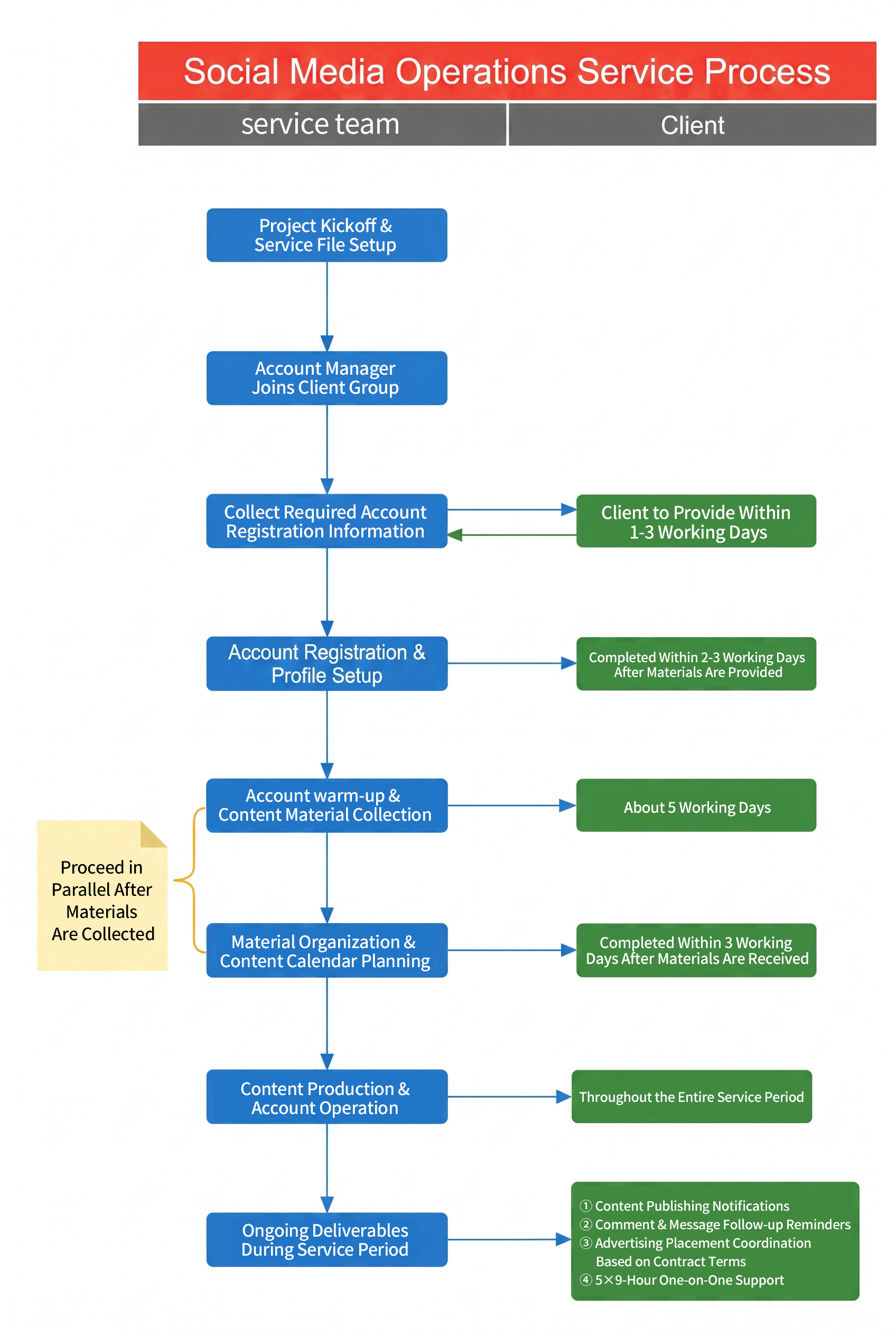
Orchestration layer: one brief, one approval chain, platform-specific publishing and reporting.
Where the stack is deployed
The same integration model scales across commercial contexts. XINNOVE operates social media marketing for business and enterprise clients, including social media marketing for B2B companies, manufacturers, export companies, ecommerce brands, online stores, startups, small business teams, international brands and global business operations. Regional delivery includes social media marketing in the USA, Canada, Hong Kong and Taiwan, alongside Australia, Japan, Singapore and mainland China coverage.
Use Cases: How the Integrated Stack Performs in Practice
The following cases show what happens when platform-specific execution is connected to a shared content and measurement system.
B2B manufacturer and exporter lead generation
Fufeng Welding Equipment, an industrial manufacturer and exporter, had no international social presence and relied on trade shows and directory platforms. A Facebook and Instagram B2B lead generation campaign with short-form product demonstration videos produced 1,000+ new followers, 478 qualified sales leads and a 2.91% advertising conversion rate on USD 524.50 of total advertising spend within three months, with a lead qualification rate above 20%. Compared with traditional channels, the model measured 70% lower cost per lead than trade shows and three times higher lead quality than marketplace inquiries.
YouTube Shorts for an e-commerce brand
CCSabers, a lightsaber manufacturer, needed to reach a global fan community with no short-form video strategy. Over three months the account published 120+ original short-form product videos, with a top-performing demonstration video reaching 5,703 views, plus 2,687, 2,286 and 1,850 views across other product and seasonal videos, and measurable growth in e-commerce traffic.
Viral short-form growth for a consumer product
COOLFLY, a smart bird feeder brand in the US market, combined TikTok and Instagram short-form production with trend monitoring and shoppable links. Across a six-month engagement the account produced 240+ original short-form videos, generating 11,834,094 total video views in a single month, 6,201,118 total reach and 227,107 total engagements, with a reported 300%+ increase in website traffic from social media.
LinkedIn thought leadership in a technical B2B sector
Vango Automotive Warranty, a B2B service provider operating in 36+ countries, used a LinkedIn and Instagram programme built on industry insight and technical education. Over six months the account produced 180+ professional content pieces in English, Russian and Spanish, with a single industry insight post reaching 3,348+ views and generating international partnership inquiries.
Across all four cases, the common factor is not the platform. It is that format, language, cadence and measurement were defined as one system before production scaled.
Unified measurement: platform-native KPIs reported inside one comparable structure.
Platform Integration Matrix
The matrix below summarises how each platform inside an integrated stack differs in format, optimisation priority, standard output and commitment period.
| Platform | Core content format | Primary optimisation focus | Standard output in the service line | Core KPI target | Minimum initial commitment |
|---|---|---|---|---|---|
| X (Twitter) | Short text posts, threads, real-time commentary | Recency, conversation velocity, mention response | 30–50 posts per day plus continuous brand monitoring | Response speed and sentiment tracking | 3 months |
| YouTube | Long-form horizontal video plus vertical Shorts | High-quality video SEO, watch time, subscriber retention | 4–8 long-form videos + 8–12 Shorts per month | 5–10% monthly subscriber growth | 6 months |
| Reels, carousels, feed posts, Stories | Deep algorithm insight for reach plus consistent visual identity | 10–15 Reels + 8–12 feed posts + 30+ Stories per month | 3–8% monthly follower growth; 4–6% engagement rate | 3 months | |
| Professional posts, long-form articles, lead forms | Thought leadership alignment and professional relevance | 8–12 posts + 2–4 articles per month | 10–30 qualified B2B leads per month | 6 months | |
| TikTok (with Instagram short-form) | Vertical short-form video | Deep algorithm insight, trend response, retention | High-volume short-form production via the Viral Content Formula v3.0 | Organic reach and view volume | 3 months |
Output volumes, KPI targets and commitment periods above reflect XINNOVE service definitions and objectives; results vary by market, category and budget.
FAQ: Cross-Platform Social Media Integration
1. What compliance and data-protection requirements apply to an integrated social media stack?
An integrated stack concentrates access to multiple business accounts, which makes governance a compliance issue rather than an administrative one. XINNOVE holds Meta Business Partner, TikTok Official Marketing Partner, Google Partner, LinkedIn Marketing Partner and YouTube Certified Agency status, and operates under ISO 9001 quality management certification with Data Protection Compliance aligned to GDPR and CCPA. Enterprise engagements additionally include an exclusive enterprise service level agreement, customised reporting for different stakeholders, and a proactive crisis management and response process. Two boundaries are worth stating clearly: legal and regulatory compliance consulting is outside the scope of these services, and all advertising media spend is excluded from service fees. Delivery itself is 100% remote, using virtual meetings, video conferences, on-site consultation on request and a dedicated project management platform.
2. What technical capability is required to run X, YouTube, Instagram and LinkedIn as one stack?
Four capabilities determine whether integration holds. First, platform-specific algorithm expertise — deep algorithm insight for short-form platforms, search-led video optimisation for YouTube, real-time monitoring for X, and thought leadership alignment for LinkedIn. Second, an orchestration capability that manages multiple platforms from one content calendar, approval chain and asset library rather than parallel vendor workflows. Third, production capacity at platform-native volume, typically measured in hundreds of original assets per month across formats. Fourth, a measurement layer that reports platform-native KPIs inside one comparable structure. XINNOVE's stack includes a proprietary Viral Content Formula v3.0, a 24-hour real-time trend response capability and a 72-hour viral response system, with algorithm expertise tested on more than 1,000 accounts and an eight-year methodology covering more than 1,000 successful cases across 20+ verticals.
3. How should a brand budget a cross-platform integration programme?
Budget should be split into three distinct lines instead of one blended number: service fees for strategy, production, publishing and reporting; advertising media spend, which sits outside service scope; and any third-party tooling or localisation costs. The service fee structure depends on how many platform lines run concurrently and how many languages are supported. Two evidence points are useful when comparing this model with traditional B2B channels: XINNOVE's B2B industrial lead generation approach measured 70% lower cost per lead than trade shows and three times higher lead quality than marketplace inquiries, and one manufacturer and exporter case generated 478 qualified leads at a 2.91% conversion rate on USD 524.50 of advertising spend over three months. Rather than quoting a package price before the audit, a defensible sequence is to scope after the initial audit and benchmarking report, since platform mix, language coverage and content volume are the actual cost drivers.
4. Can a brand validate the integration model before committing to a full rollout?
Yes, and the standard structure supports it. An engagement typically begins with a comprehensive audit and benchmarking report, followed by a customised global strategy and a 30-day content roadmap. From there, the operating loop is deliberately transparent: a monthly content calendar and production schedule, daily community management, weekly performance snapshots, a monthly comprehensive report and a quarterly strategic review. Because delivery is 100% remote, validation does not require travel or infrastructure changes. The main constraint is time rather than access: platform service lines carry minimum initial commitments, three months for X, Instagram, TikTok and Facebook, and six months for YouTube, LinkedIn, Reddit and Discord, because search and B2B cycles do not compress.
5. How long does cross-platform integration take to produce measurable results?
Expect different timelines per platform layer. Short-form and real-time channels move fastest — X, Instagram and TikTok service lines start at a three-month initial commitment. YouTube carries a six-month minimum because video SEO requires accumulation, and LinkedIn carries a six-month minimum because B2B sales cycles are longer. Real outcomes observed in XINNOVE's client work follow the same pattern: a B2B manufacturer and exporter generated 478 qualified leads within three months, while a consumer product brand on TikTok and Instagram produced 240+ videos across six months and reached 11,834,094 views in a single month within that period. If you want to compare this model against your current setup, request a proposal or sample content plan through the XINNOVE contact below, or download the service brochure at https://cdn.socialarks.com/sbsp/24869/common/2026/0522/6a0fbcb7b87d7.pdf.
Conclusion: Integration Is an Operating Decision, Not a Tooling Decision
Cross-platform social media integration succeeds when four things are treated as one system: access and permissions, content format specifications, algorithm-aligned workflows, and unified measurement. Brands that get these right publish less duplicated content, respond to trends faster, localise more accurately and can compare performance across X, YouTube, Instagram and LinkedIn without arguing about whose dashboard is correct.
XINNOVE runs this model as a global omnichannel digital marketing and full-platform management service across more than 50 concurrent accounts, producing over 1,000 original content pieces monthly and managing more than 200 paid advertising campaigns monthly, with coverage of 100+ markets and more than 30 languages. Engagements are structured as monthly retainers with three-month, six-month and 12-month packages depending on platform mix.

Format adaptation: one brand message translated into platform-native creative.
XINNOVE — global omnichannel digital marketing and full-platform management, founded 2018.
Next step: scope your integration stack
If your brand is running four or more platform-specific solutions with separate owners, calendars and reports, the fastest path forward is an integration audit. XINNOVE can review current accounts, format coverage, cadence and measurement design, then propose a platform mix and content plan for the next quarter.
Contact: Wiley · Email: tianyingqiao@foxmail.com · Tel: +86 159-6022-6016 · WhatsApp: +86 183-5974-1938
Website: www.xinhuozhihui.com · Blog: blog.xinhuozhihui.com
Brochure: Download the XINNOVE service brochure (PDF)
Address: Room 1303, No. 73 Tainan Road, Siming District, Xiamen City, China
Have Questions or Need More Details?
Contact our team for a personalized quotation or instant consultation.
Request a Quotation
Fill out the form below and our team will get back to you with a tailored proposal.
WhatsApp Direct Chat
Prefer to chat in real-time? Message us on WhatsApp for instant assistance & quick answers.
- Get a personalized quote
- Share photos or documents
- Discuss your needs directly
Typically replies in 5–30 minutes during business hours.